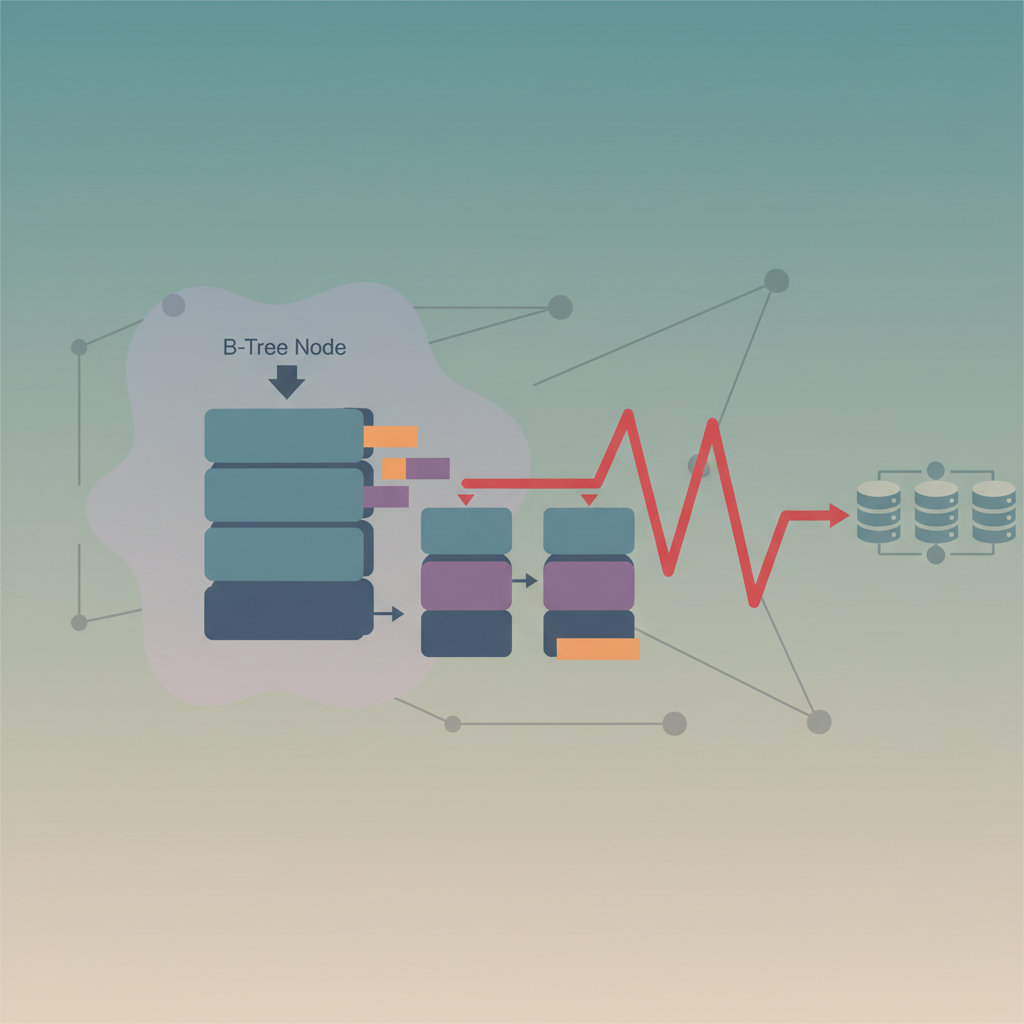
TL;DR — When a B‑Tree node splits, it forces extra locks, cache churn, and bursty I/O that together create rare but severe latency spikes, inflating the tail of response‑time distributions.
B‑Tree indexes are the workhorse of almost every relational and key‑value store. They give us logarithmic look‑up cost and ordered iteration, but the very mechanism that keeps the tree balanced—node splitting—can also be the source of unexpected latency outliers. In this article we dissect the split operation, explain how it interacts with modern hardware and concurrency control, and surface practical techniques to keep tail latency under control.
Anatomy of a B-Tree
A B‑Tree is a multi‑way search tree where each internal node holds k keys and k + 1 child pointers. The branching factor k is chosen so that a node fits comfortably into a single page (often 4 KB or 8 KB). The invariants are simple:
- Keys in a node are sorted.
- All leaves reside at the same depth.
- Each node (except the root) contains at least ⌈k/2⌉ keys.
Because of these invariants, insertion is cheap most of the time: we descend the tree, find the leaf, and insert the key in place. The heavy work happens when the leaf is already full.
Insert Path Walkthrough
def btree_insert(root, key, value):
    # 1. Find leaf
    leaf = descend_to_leaf(root, key)
    # 2. If leaf has room, insert directly
    if len(leaf.keys) < leaf.max_keys:
        leaf.keys.append(key)
        leaf.values.append(value)
        leaf.keys.sort()
        leaf.values = [v for _, v in sorted(zip(leaf.keys, leaf.values))]
        return
    # 3. Otherwise, split the leaf
    new_leaf, median = split_node(leaf)
    # 4. Promote median to parent (recursive)
    insert_into_parent(leaf.parent, median, new_leaf)
The split_node routine is where latency surprises begin to surface.
What Is Tail Latency?
Tail latency measures the high‑percentile response times (e.g., 95th, 99th, 99.9th). While average latency may stay low, a handful of requests can take orders of magnitude longer, hurting user experience and SLA compliance. In distributed systems, tail latency often dominates overall job completion time because parallel tasks must all finish.
Key contributors to tail latency include:
- Lock contention – multiple threads waiting on a single lock.
- Cache eviction – data being flushed from CPU caches, causing stalls.
- I/O bursts – sudden spikes in disk or SSD writes that exceed bandwidth.
Node splitting is a perfect storm that can trigger each of these.
Node Splitting Mechanics
When a leaf overflows, we must split it into two nodes and promote a separator key to the parent. The classic algorithm:
- Allocate a new node
N'. - Move the upper half of keys (and values) from the full node
NtoN'. - Choose the middle key
K_midas the separator. - Insert
K_midinto the parent; if the parent is also full, recurse upwards (potentially splitting the root).
Pseudo‑Code
// C‑style split of a B‑Tree leaf node
void split_leaf(Node *leaf) {
    Node *new_leaf = allocate_node();
    int mid = leaf->key_count / 2;

    // Move upper half to new leaf
    memcpy(new_leaf->keys, leaf->keys + mid, (leaf->key_count - mid) * sizeof(Key));
    memcpy(new_leaf->values, leaf->values + mid, (leaf->key_count - mid) * sizeof(Value));

    new_leaf->key_count = leaf->key_count - mid;
    leaf->key_count = mid;

    // Link siblings
    new_leaf->next = leaf->next;
    leaf->next = new_leaf;

    // Promote middle key to parent
    insert_into_parent(leaf->parent, leaf->keys[mid - 1], new_leaf);
}
The algorithm looks straightforward, but each step interacts with the system stack in ways that amplify latency.
How Splits Amplify Latency
1. Locking and Contention
Most storage engines protect a node with a fine‑grained latch (often a mutex or a read‑write lock). During a split:
- The leaf’s latch must be held exclusively because keys are being moved.
- The parent’s latch must also be held to insert the separator.
- If the parent is also full, the split propagates upward, acquiring multiple latches in a single logical operation.
In a high‑concurrency workload, many threads may be inserting into different leaves that share the same parent. When a split occurs, those threads suddenly compete for the parent latch, causing a lock convoy. The convoy’s duration is proportional to the amount of data moved and the number of pages that need to be flushed.
Note: In PostgreSQL, this phenomenon is described as “page split lock contention” and can be observed with
pg_lockswhile running a bulk INSERT workload.
2. Cache Eviction and Page Faults
A split forces the allocation of a fresh page (or SSD block). The newly allocated page is cold: it is not in the CPU’s L1/L2 caches, nor in the OS page cache. Accessing it triggers:
- Cache miss – the CPU must fetch the page from main memory, incurring ~100 ns latency on modern DDR5.
- TLB miss – the new virtual‑to‑physical mapping may not be in the Translation Lookaside Buffer, causing an extra lookup.
- Potential page fault – if the allocation pushes the system’s memory pressure over a threshold, the OS may need to evict another page, leading to a page‑in from swap or NVMe.
When many splits happen in a short window (e.g., during a bulk load), the cache churn can saturate the memory bandwidth, and the latency of a single INSERT can jump from a few microseconds to several milliseconds.
3. Write Amplification and Flush Storms
Modern storage engines use a write‑ahead log (WAL) and background flushing. Splitting produces two kinds of writes:
- Data page writes – the modified leaf and its new sibling must be persisted.
- Metadata writes – the parent node receives a new separator key, and possibly a new internal node if the split propagates.
If the system is configured with a small write buffer (e.g., RocksDB’s write_buffer_size), a split can push the buffer over its limit, triggering an immediate flush to the underlying SSD. Flushes are typically I/O‑intensive, and when multiple threads cause concurrent flushes, the SSD’s internal write queue can become saturated, resulting in write latency spikes.
In cloud environments with shared SSDs, this effect is magnified because the I/O bandwidth is a shared, noisy‑neighbor resource. The spike shows up as a tail latency outlier for the transaction that caused the split.
4. Propagation Cascades
A split at the leaf can cause a split at the parent, which may cause a split at the grandparent, and so on up to the root. Each level adds:
- Additional lock acquisitions.
- Extra page allocations.
- More WAL entries.
The probability of a cascade grows with the fill factor of the tree. If most nodes are near capacity (e.g., 90 % full), a single insert has a high chance of triggering a multi‑level split. Empirical studies (see the InnoDB “insert buffer” paper) show that such cascades can increase the 99th‑percentile latency by 5‑10× compared to the median.
Mitigation Strategies
Tune Fill Factor
Most engines allow setting a target fill factor (e.g., innodb_fill_factor). By leaving ~20 % slack in each node, the likelihood of a split drops dramatically.
# Example for MySQL InnoDB
mysql> SET GLOBAL innodb_fill_factor = 80;
A lower fill factor trades a modest increase in space usage for a large reduction in split‑induced latency spikes.
Use Adaptive Latching
Instead of a single exclusive latch per node, employ optimistic concurrency control or lock coupling:
- Readers acquire a shared latch and validate after traversal.
- Writers acquire exclusive latch only on the node that actually changes, releasing parent latches early.
Projects like Google LevelDB adopt lock‑free insertion for leaf nodes, which reduces contention during splits.
Pre‑allocate Sibling Pages
Allocate a “future sibling” page during normal operation (e.g., when a node reaches 70 % capacity). When a split finally occurs, the engine can reuse the pre‑allocated page without invoking the allocator, avoiding a sudden allocation burst.
Batch Inserts
Bulk‑loading tools (e.g., PostgreSQL’s COPY, RocksDB’s BulkLoad) insert rows in sorted order, which minimizes splits because data lands in sequential pages. Even when splits are unavoidable, they happen in a controlled, single‑threaded phase, preventing concurrent lock convoys.
Write‑Buffer Sizing
Increasing the write buffer size gives the engine more breathing room before a flush is forced. However, this must be balanced against memory pressure. In RocksDB, the following settings help:
write_buffer_size: 256MB
max_write_buffer_number: 4
Larger buffers reduce the frequency of flush storms triggered by splits.
Monitoring and Alerting
Track tail latency metrics (p99, p99.9) alongside split counters (num_splits, split_cascade_depth). When a correlation appears, trigger a diagnostic run:
# Example using Prometheus query language (PromQL)
rate(btree_node_splits_total[1m]) > 0.5 and histogram_quantile(0.99, rate(insert_latency_seconds_bucket[5m])) > 0.01
Early detection lets you adjust fill factor or throttle bulk loads before SLAs are violated.
Key Takeaways
- Node splitting acquires multiple exclusive latches, creating lock convoys that dominate tail latency under high concurrency.
- Cold page allocation during a split forces cache and TLB misses, adding microsecond‑scale stalls that compound with other latency sources.
- Write amplification from data and metadata page writes can trigger flush storms, especially when write buffers are small.
- Cascading splits magnify all of the above, turning a single leaf split into a multi‑level latency event.
- Mitigations include tuning fill factor, adopting optimistic concurrency, pre‑allocating sibling pages, batching inserts, and sizing write buffers appropriately.
Further Reading
- PostgreSQL Documentation – Concurrency Control
- RocksDB Blog – Write Amplification and Compaction
- MySQL InnoDB Architecture Overview
- Google LevelDB – Log-Structured Merge Trees
- [The Art of Performance – Tail Latency in Distributed Systems](https://queue.acm.org/detail.cfm?id=3020955