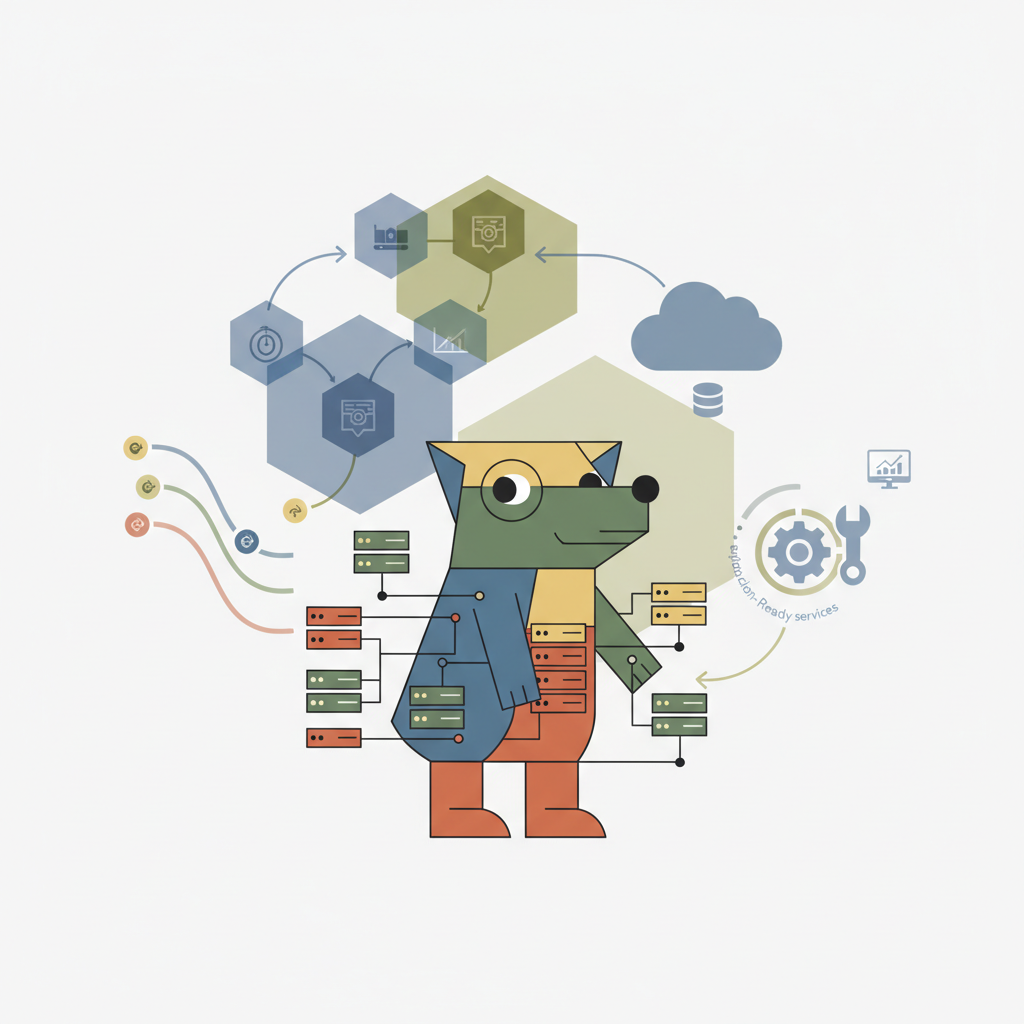
TL;DR — Go’s static typing, lightweight goroutines, and thriving ecosystem let you design hexagonal, event‑driven backends that scale, stay observable, and survive real‑world failures. This post walks through concrete architecture patterns, concurrency best‑practices, and production‑ready tooling you can adopt today.
Modern backend teams are under pressure to ship features fast, keep latency low, and stay resilient under traffic spikes. Go (often called Golang) has become the lingua franca for many of those teams because it hits the sweet spot between developer productivity and runtime efficiency. Below we unpack how to architect a Go service, leverage concurrency without falling into classic pitfalls, and hard‑enforce production readiness with observability, graceful shutdown, and CI/CD.
Why Go Is a Fit for Modern Backend Engineering
| Feature | What It Means for Engineers | Real‑World Example |
|---|---|---|
| Compiled, zero‑garbage‑collection pause | Predictable latency, easier capacity planning | High‑frequency trading platform using Go for sub‑millisecond order routing |
| First‑class concurrency (goroutine + channel) | Write async pipelines with far less boilerplate than Java or Python | Kafka consumer groups that fan‑out to thousands of goroutines |
| Strong static typing & interfaces | Compile‑time contract enforcement, easier refactoring | Hexagonal architecture where adapters implement domain interfaces |
| Rich standard library | No need for external HTTP or JSON libraries for most use‑cases | Internal microservice exposing a JSON API via net/http |
| Built‑in tooling (go fmt, go vet, go test) | Consistent code style, fast feedback loops | CI pipelines that run go test ./... and golangci-lint run on every PR |
These traits are not abstract buzzwords; they translate directly into production metrics—lower CPU overhead, fewer runtime panics, and faster incident recovery.
Architecture Patterns in Go
Hexagonal (Ports & Adapters) Architecture
Hexagonal architecture separates core business logic (the “domain”) from external concerns like databases, message brokers, or HTTP servers. In Go, interfaces make this separation trivial.
// domain.go
type OrderRepository interface {
    Create(ctx context.Context, o *Order) error
    FindByID(ctx context.Context, id string) (*Order, error)
}

// service.go
type OrderService struct {
    repo OrderRepository
}

func (s *OrderService) PlaceOrder(ctx context.Context, req PlaceOrderRequest) (*Order, error) {
    // business rules, validation, etc.
    order := &Order{...}
    if err := s.repo.Create(ctx, order); err != nil {
        return nil, err
    }
    return order, nil
}
- Ports are the interfaces (
OrderRepository). - Adapters are concrete implementations (Postgres, DynamoDB, in‑memory mock).
- The HTTP handler becomes a thin driver that translates HTTP requests into domain calls.
Production tip: Wire adapters at startup using a DI container like uber-go/fx or the built‑in
initpattern. This keeps the binary monolithic yet testable.
Event‑Driven Microservices with Kafka
Go’s confluent‑kafka‑go client and the sarama library give you low‑latency, high‑throughput Kafka consumers. Pair this with the hexagonal approach: the consumer is an adapter that pushes messages into the domain.
// consumer.go
func consumeOrders(ctx context.Context, consumer sarama.ConsumerGroup, svc *OrderService) error {
    handler := func(msg *sarama.ConsumerMessage) error {
        var ev OrderPlacedEvent
        if err := json.Unmarshal(msg.Value, &ev); err != nil {
            return err
        }
        // Domain call – no Kafka knowledge inside
        _, err := svc.PlaceOrder(ctx, ev.ToRequest())
        return err
    }

    // Run the group loop
    for {
        if err := consumer.Consume(ctx, []string{"orders"}, handler); err != nil {
            return err
        }
        if ctx.Err() != nil {
            return ctx.Err()
        }
    }
}
Key production patterns
- Exactly‑once processing – use idempotent writes or a deduplication store.
- Back‑pressure – pause consumption when downstream services saturate (see the “Goroutine Pool” pattern below).
- Dead‑letter topics – route malformed messages instead of crashing the consumer.
Service Mesh Integration
When you run Go services on Kubernetes, a service mesh like Istio or Linkerd adds mutual TLS, traffic routing, and distributed tracing without code changes. The only Go‑specific step is to expose metrics in the Prometheus format (see Observability section).
Concurrency Primitives and Patterns
Goroutine Pools for Bounded Parallelism
Spawning a goroutine per request is cheap, but unbounded fan‑out can exhaust file descriptors or memory. A pool limits concurrency.
// pool.go
type WorkerPool struct {
    jobs   chan func()
    wg     sync.WaitGroup
    cancel context.CancelFunc
}

func NewWorkerPool(maxWorkers int) *WorkerPool {
    ctx, cancel := context.WithCancel(context.Background())
    p := &WorkerPool{
        jobs:   make(chan func()),
        cancel: cancel,
    }
    p.wg.Add(maxWorkers)
    for i := 0; i < maxWorkers; i++ {
        go func() {
            defer p.wg.Done()
            for {
                select {
                case job := <-p.jobs:
                    job()
                case <-ctx.Done():
                    return
                }
            }
        }()
    }
    return p
}

func (p *WorkerPool) Submit(job func()) {
    p.jobs <- job
}

func (p *WorkerPool) Shutdown() {
    p.cancel()
    close(p.jobs)
    p.wg.Wait()
}
- Use
NewWorkerPool(runtime.NumCPU() * 2)for CPU‑bound work. - For I/O‑bound workloads (e.g., HTTP calls), scale the pool based on observed latency percentiles.
Context Propagation
Go’s context.Context is the de‑facto way to carry deadlines, cancellation signals, and request‑scoped values across API boundaries.
func fetchUser(ctx context.Context, id string) (*User, error) {
    req, _ := http.NewRequestWithContext(ctx, http.MethodGet, fmt.Sprintf("%s/users/%s", apiBase, id), nil)
    resp, err := http.DefaultClient.Do(req)
    if err != nil {
        return nil, err
    }
    defer resp.Body.Close()
    // …
}
- Never store a
contextin a struct – pass it explicitly. - Do not use
context.Background()in request handlers; always derive from the incoming request’s context.
Select‑Based Coordination
When you need to wait on multiple channels (e.g., a result channel and a timeout), select is the idiomatic tool.
select {
case res := <-resultCh:
    // handle success
case <-time.After(2 * time.Second):
    // timeout handling
case <-ctx.Done():
    // request cancelled upstream
}
Avoiding Common Pitfalls
| Pitfall | Symptom | Remedy |
|---|---|---|
| Leaking goroutines | Process memory grows, go routine leak alerts in logs | Ensure every goroutine reads from a done channel or respects ctx.Done() |
| Race conditions | go test -race reports data races | Keep shared mutable state behind sync primitives (sync.Mutex, atomic) |
| Unbounded channel buffers | Sudden OOM crashes | Use bounded channels and back‑pressure (e.g., select with a default case) |
Production‑Ready Service Design
Observability: Metrics, Traces, and Logs
Metrics – Expose Prometheus counters & histograms via
/metrics.var ( httpRequests = prometheus.NewCounterVec( prometheus.CounterOpts{ Name: "http_requests_total", Help: "Total number of HTTP requests", }, []string{"method", "code"}, ) )Register with
prometheus.MustRegister(httpRequests)ininit().Tracing – Use OpenTelemetry with the Go SDK. Export to Jaeger or Google Cloud Trace.
tp := oteltrace.NewTracerProvider(
    oteltrace.WithBatcher(exporter),
    oteltrace.WithResource(resource.NewWithAttributes(
        semconv.SchemaURL,
        semconv.ServiceNameKey.String("order-service"),
    )),
)
otel.SetTracerProvider(tp)
Structured Logging –
zaporzerologprovide JSON logs that are easy to parse. Include request IDs (X-Request-ID) in every log line.
Best practice: Correlate logs, metrics, and traces via a common request ID. This makes root‑cause analysis in a distributed system much faster.
Graceful Shutdown and Signal Handling
A production service must stop accepting new work, finish in‑flight requests, and release resources.
func main() {
    srv := &http.Server{Addr: ":8080", Handler: router}
    // Start server in a goroutine
    go func() {
        if err := srv.ListenAndServe(); err != nil && err != http.ErrServerClosed {
            log.Fatal(err)
        }
    }()

    // Listen for termination signals
    stop := make(chan os.Signal, 1)
    signal.Notify(stop, os.Interrupt, syscall.SIGTERM)

    <-stop // block until signal received
    ctx, cancel := context.WithTimeout(context.Background(), 10*time.Second)
    defer cancel()
    if err := srv.Shutdown(ctx); err != nil {
        log.Fatalf("Graceful shutdown failed: %v", err)
    }
    log.Println("Service stopped")
}
- Timeout – Choose a shutdown timeout that matches your SLAs (e.g., 10 s).
- Drain connections – In Kubernetes, set
terminationGracePeriodSecondsto the same value.
Configuration Management
- Use environment variables for 12‑factor compliance (
PORT,DATABASE_URL). - For complex configs, leverage
github.com/spf13/viperwith a hierarchy: defaults → config file → env vars → flags. - Validate config at startup; panic early if required values are missing.
Security Hardening
- TLS everywhere – Enforce HTTPS in ingress and service‑to‑service calls (
http.Transport{TLSClientConfig: …}). - Dependency scanning – Run
go list -m -u alland integrategovulncheckinto CI. - Rate limiting – Implement token bucket per client IP using
golang.org/x/time/rate.
Deployment and CI/CD on GCP
Containerization – Multi‑stage Dockerfile, base on
gcr.io/distroless/static-debian12.FROM golang:1.22-alpine AS builder WORKDIR /src COPY . . RUN CGO_ENABLED=0 GOOS=linux GOARCH=amd64 go build -ldflags="-s -w" -o /app . FROM gcr.io/distroless/static-debian12 COPY --from=builder /app /app ENTRYPOINT ["/app"]Cloud Build –
cloudbuild.yamlrunsgo test,golangci-lint, and pushes the image to Artifact Registry.Anthos/GKE – Deploy as a Deployment with readiness/liveness probes, Horizontal Pod Autoscaler (target CPU 60 %). Example probe:
readinessProbe:
  httpGet:
    path: /healthz
    port: 8080
  initialDelaySeconds: 5
  periodSeconds: 10
Canary Releases – Use Cloud Deploy to gradually shift traffic, monitor error rates via Cloud Monitoring, and roll back automatically.
Key Takeaways
- Go’s lightweight goroutine model and static typing let you build hexagonal or event‑driven backends that stay maintainable at scale.
- Concurrency is safe when you bound parallelism, propagate contexts, and avoid leaks; patterns like worker pools and select‑based coordination are battle‑tested.
- Production readiness hinges on observability (metrics, traces, structured logs), graceful shutdown, and automated security scanning.
- Deploying on GCP with Docker, Cloud Build, and GKE gives you a repeatable pipeline that supports canary and blue‑green strategies out of the box.
- Treat every external dependency (DB, Kafka, HTTP client) as an adapter behind an interface; this isolates business logic and makes unit testing trivial.
Further Reading
- The Go Programming Language Blog – official announcements, language design, and performance tips.
- Go Concurrency Patterns: Context, Cancellation, and Timeouts – deep dive into idiomatic concurrency.
- Kubernetes Best Practices – guidance on probes, autoscaling, and rolling updates.