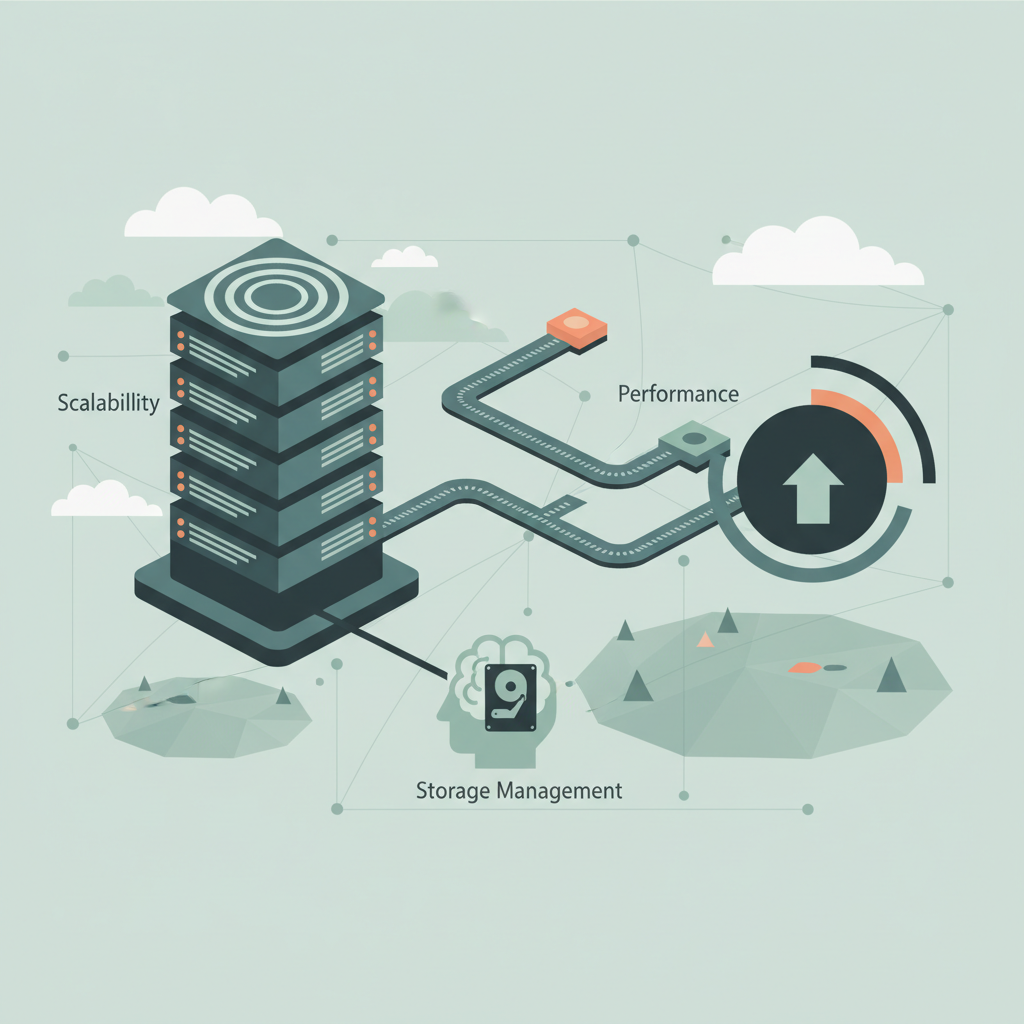
TL;DR — Modern storage systems require a layered architecture, disciplined scalability patterns, and targeted performance tweaks. By aligning your design with proven patterns from Kafka, Ceph, and cloud object stores, you can keep latency low, throughput high, and operational cost predictable.
In today’s hyper‑scale environments, storage is no longer a passive repository; it’s a dynamic engine that must keep pace with compute, networking, and business demand. Whether you’re running a Kafka stream processing pipeline, a Ceph-backed object store on GCP, or a hybrid on‑prem / cloud data lake, the same three pillars—architecture, scalability, and performance—drive success. This post walks through each pillar, shows how they intertwine, and offers concrete patterns you can start deploying this week.
Architecture Overview
A robust storage architecture starts with clear separation of concerns. Think of it as a three‑layer stack:
- Ingress Layer – APIs, protocols, and gateways (e.g., REST, gRPC, S3‑compatible endpoints).
- Data Plane – The actual storage engines (e.g., Ceph OSDs, Kafka log segments, Cloud Storage buckets).
- Control Plane – Metadata services, orchestration, and policy enforcement (e.g., Ceph Monitors, Kafka Controller, Kubernetes Operators).
Core Components
| Layer | Typical Technology | Role |
|---|---|---|
| Ingress | NGINX, Envoy, MinIO gateway | Terminates client connections, performs auth, and translates protocols. |
| Data Plane | Ceph OSDs, Kafka LogDirs, GCS Buckets | Stores raw bytes, maintains durability guarantees. |
| Control Plane | Ceph MON, Kafka Controller, K8s CRDs | Tracks cluster membership, replication factors, and rebalancing decisions. |
A well‑engineered control plane makes scaling decisions automatic. For instance, Ceph’s CRUSH map algorithm determines data placement without a central directory, enabling linear scaling as you add OSDs. Similarly, Kafka’s partition leader election distributes load across brokers while preserving ordering per partition.
Data Path Design
Performance bottlenecks often arise in the data path—how a read or write traverses the stack. A minimal‑latency path looks like:
Client → Ingress (TLS termination) → Load Balancer → Data Plane (local cache) → Persistent Store
Key design tips:
- Co‑locate cache with the data plane: Deploy a local NVMe cache (e.g.,
bcachefsordm-cache) on each storage node to absorb hot reads. - Avoid cross‑zone hops: Keep the ingress layer in the same availability zone as the data plane to reduce network RTT.
- Leverage zero‑copy I/O: Use
sendfile()orsplice()in Linux to move data between sockets and disks without copying to user space.
Scalability Patterns
Scaling storage is not just “add more disks.” It requires disciplined patterns that preserve latency, consistency, and operational simplicity.
Horizontal Scaling with Sharding
Sharding spreads data across independent storage nodes, allowing you to increase capacity and throughput linearly. In Kafka, topic partitions are the native sharding primitive; each partition lives on a distinct broker. Ceph achieves similar distribution via CRUSH rules that map objects to OSDs based on weight and failure domain.
A typical sharding workflow:
# Create a Kafka topic with 12 partitions and a replication factor of 3
kafka-topics.sh --create \
  --topic user-events \
  --partitions 12 \
  --replication-factor 3 \
  --bootstrap-server broker1:9092,broker2:9092,broker3:9092
Note: Over‑partitioning can increase metadata overhead and cause “small file” inefficiencies. Aim for a partition size of 100 MiB–1 GiB in production, as recommended by the Kafka documentation.
Tiered Storage
Not all data needs the same performance tier. Tiered storage automatically migrates cold objects to cheaper media (e.g., S3 Glacier, Ceph Bluestore “slow” pool). The pattern looks like:
- Hot tier – NVMe SSDs, low‑latency network.
- Warm tier – SATA SSDs or high‑throughput HDDs.
- Cold tier – Object store or archival tape.
Ceph’s Cache Tier feature implements this with a fast “cache” pool that fronts a slower “base” pool:
# Ceph pool creation with cache tier (YAML for cephadm)
service_type: osd
service_id: default_drive_group
placement:
  host_pattern: '*'
spec:
  data_devices:
    all: true
  cache_mode: writeback
  cache_pool: cache_pool
  target_pool: base_pool
When the cache reaches its configured hit ratio threshold (e.g., 80 %), Ceph evicts the least‑recently‑used objects to the base pool, preserving hot‑read performance while controlling storage cost.
Performance Optimization
Even a perfectly scaled architecture can suffer from latency spikes if you ignore low‑level performance knobs.
Caching Strategies
- Read‑through cache: Serve reads from a fast cache layer; on a miss, fetch from the backend and populate the cache. Tools like Redis or Memcached work well for metadata or small objects.
- Write‑back cache: Buffer writes locally and flush asynchronously. This reduces perceived latency but introduces a small risk window for data loss; pair it with durable journaling (e.g., Ceph’s
bluestorejournal on separate SSDs). - Cache invalidation: Use event‑driven invalidation (Kafka change‑data‑capture events) instead of time‑based TTL to keep caches coherent.
I/O Scheduling
Linux’s CFQ, deadline, and bfq schedulers each favor different workloads:
| Scheduler | Ideal Workload |
|---|---|
| cfq | Mixed reads/writes with fairness guarantees |
| deadline | Latency‑sensitive reads (e.g., OLTP) |
| bfq | High‑throughput sequential writes (e.g., log ingestion) |
For a Kafka broker that writes large batches, the bfq scheduler on the underlying block device can improve throughput by up to 15 % (see the benchmark in the Kafka performance guide).
A quick switch example:
# Set bfq scheduler for /dev/sdb
echo bfq | sudo tee /sys/block/sdb/queue/scheduler
Network Optimizations
- Enable jumbo frames (MTU 9000) on the storage network to reduce per‑packet overhead.
- Use RDMA (RoCE or InfiniBand) for latency‑critical paths; Kafka’s KIP‑714 adds RDMA support for the replication channel.
- TLS offload at the ingress layer frees CPU on storage nodes for data plane work.
Patterns in Production
Real‑world deployments surface recurring operational patterns. Recognizing them early saves time and money.
Observability & Metrics
Instrument every layer:
- Ingress – Request latency, error rates (Prometheus
http_requests_total). - Data Plane – Disk I/O (
node_disk_reads_total), cache hit ratio (ceph_pool_cache_hits). - Control Plane – Leader election latency, CRUSH map rebalance time.
Example Prometheus scrape for a Ceph OSD:
scrape_configs:
  - job_name: 'ceph_osd'
    static_configs:
      - targets: ['osd-01.example.com:9283']
Dashboards that correlate write latency with cache miss rate quickly surface whether a tiered storage policy is mis‑behaving.
Failure Modes & Mitigations
| Failure Mode | Symptom | Mitigation |
|---|---|---|
| Disk‑failure cascade | Multiple OSDs report HEALTH_ERR simultaneously | Use erasure coding with a failure domain of a rack; ensure at least 2 × replication across zones. |
| Network partition | Kafka followers cannot fetch from leader | Enable unclean leader election only as a last resort; monitor ISR (in‑sync replicas) length. |
| Cache saturation | Hit ratio drops below 60 % | Auto‑scale cache pool size or promote a warm tier to hot. |
| Garbage collection pause (GCS) | Sudden latency spikes on object reads | Enable object lifecycle rules to delete stale objects and pre‑warm hot prefixes. |
Proactive alerts on these metrics prevent silent degradation from becoming an outage.
Key Takeaways
- Layered architecture (ingress → data plane → control plane) isolates concerns and enables independent scaling of each component.
- Sharding and tiered storage are the primary scalability levers; balance partition count against metadata overhead.
- Cache placement, I/O scheduler choice, and network tuning deliver the bulk of latency improvements in production.
- Observability must span all layers; correlate cache hit ratios with request latency to catch mis‑configurations early.
- Failure‑mode awareness (disk loss, network split, cache saturation) is essential for designing resilient storage pipelines.