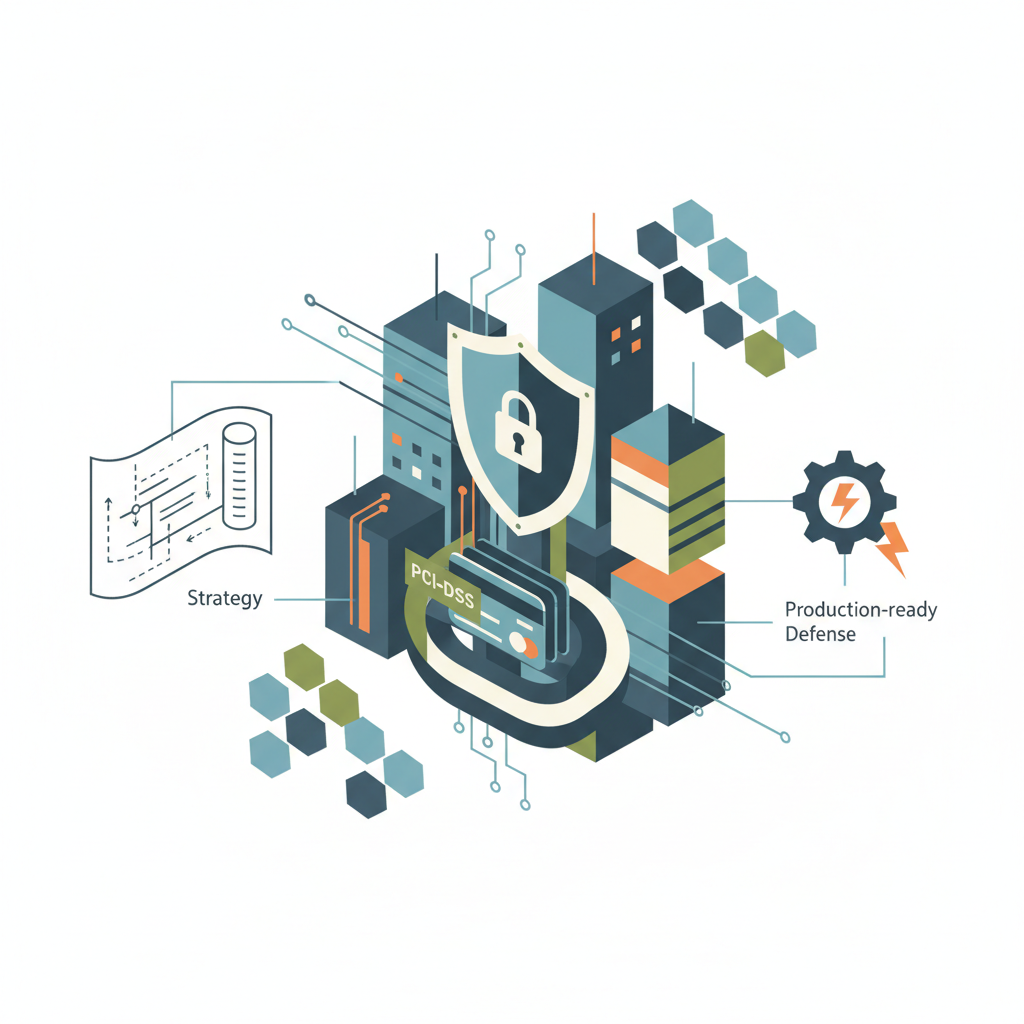
TL;DR — Secure payments at scale start with a clear strategy, strict PCI‑DSS alignment, and reusable defense patterns like tokenization, webhook verification, and zero‑trust network segmentation. Implement these with cloud‑native services (e.g., AWS KMS, GCP Secret Manager) and observability tooling to keep compliance auditable and attacks detectable.
Enterprises that process billions of dollars each year cannot treat payments as an after‑thought. A single breach not only threatens revenue but also erodes brand trust and invites hefty regulatory fines. This post walks through a practical, production‑ready approach to payments security: from high‑level strategy, through the compliance maze, down to concrete patterns you can copy‑paste into your own architecture.
1. Strategic Foundations
Before you draw any diagram, answer three governance questions:
- What is in scope? Identify every system that touches cardholder data (CHD) – from front‑end SDKs to back‑office batch jobs.
- Who owns it? Assign a Payments Security Owner (often a senior engineer or product security manager) with authority over policies, tooling, and incident response.
- What is the risk tolerance? Use a risk matrix that balances fraud loss, compliance cost, and operational overhead.
1.1 Threat Modeling with STRIDE
| Threat | Example in Payments | Mitigation |
|---|---|---|
| Spoofing | Fake payment gateway URL | DNSSEC, mutual TLS |
| Tampering | Altered webhook payload | HMAC verification, immutable logs |
| Repudiation | Customer claims they never paid | End‑to‑end audit trail (signed receipts) |
| Information Disclosure | Exposed PAN in logs | Tokenization, log redaction |
| Denial of Service | Flooded tokenization service | Rate limiting, autoscaling |
| Elevation of Privilege | Privileged API key leak | Vault‑based secret rotation |
Document this matrix in a living Confluence page or a Markdown repo; keep it version‑controlled alongside your IaC.
2. Compliance Landscape
2.1 PCI DSS 4.0 – The Non‑Negotiable Baselines
PCI DSS is the de‑facto standard for card data protection. The most relevant requirements for modern cloud stacks are:
| Requirement | What It Means | Typical Cloud Controls |
|---|---|---|
| 1.1 | Install and maintain a firewall | VPC security groups, AWS Network ACLs |
| 3.2 | Protect stored CHD | Tokenization, encryption at rest using KMS |
| 4.1 | Encrypt transmission of CHD | TLS 1.2+ with strong cipher suites |
| 6.4 | Secure development practices | Static analysis, CI/CD gate |
| 7.2 | Least privilege access | IAM roles, short‑lived credentials |
| 10.6 | Log all access to CHD | CloudTrail, Audit Logs, immutable S3 bucket |
| 12.3 | Incident response plan | Runbooks, automated containment scripts |
You don’t need to be a PCI auditor to map these to native services. For example, AWS’s Control Tower provides a pre‑approved baseline that satisfies many of the above.
2.2 Global Data‑Protection Regulations
Beyond PCI, consider GDPR, CCPA, and local data‑residency laws. They impact:
- Where you store tokenized data (region‑locked buckets).
- How long you retain logs (retention policies).
- Who can access personal identifiers (role‑based access control).
Build a compliance matrix that cross‑references each regulation with the relevant data store.
3. Architecture Blueprint
Below is a reference architecture that works on AWS, GCP, or Azure with minor tweaks. The diagram (omitted here) consists of:
- Client‑Facing API Gateway – terminates TLS, validates JWT, forwards to a Payments Service.
- Payments Service – stateless microservice written in Go/Java, performs tokenization via Vault or AWS KMS and calls external processors (Stripe, Adyen).
- Webhook Receiver – validates HMAC signatures, writes events to an Event Bus (Kafka, Pub/Sub).
- Data Lake – stores encrypted audit logs, token‑to‑PAN mapping in a Highly‑Encrypted PostgreSQL cluster.
- Observability Stack – OpenTelemetry collectors feeding Grafana Loki for logs, Prometheus for metrics, and Falco for runtime security.
3.1 Tokenization Service Example (Python)
import boto3
import base64
import os
import json
from botocore.exceptions import ClientError

kms = boto3.client('kms', region_name='us-east-1')
TABLE_NAME = os.getenv('TOKEN_TABLE')

def tokenize(pan: str) -> str:
    # Encrypt PAN with a dedicated KMS key
    try:
        resp = kms.encrypt(
            KeyId='alias/payments-token-key',
            Plaintext=pan.encode(),
        )
        token = base64.urlsafe_b64encode(resp['CiphertextBlob']).decode()
        # Store mapping in DynamoDB for reversal (if needed)
        dynamodb = boto3.resource('dynamodb')
        table = dynamodb.Table(TABLE_NAME)
        table.put_item(Item={'token': token, 'created_at': int(time.time())})
        return token
    except ClientError as e:
        raise RuntimeError(f"KMS encryption failed: {e}")

def detokenize(token: str) -> str:
    ciphertext = base64.urlsafe_b64decode(token.encode())
    resp = kms.decrypt(CiphertextBlob=ciphertext)
    return resp['Plaintext'].decode()
Key points:
- Use a dedicated KMS key with rotation enabled.
- Store only the token, never the raw PAN, in downstream services.
- Keep the reversible mapping isolated behind strict IAM policies.
3.2 Webhook Verification (Node.js)
const crypto = require('crypto');
const express = require('express');
const app = express();
app.use(express.json());

const SECRET = process.env.WEBHOOK_SECRET; // from GCP Secret Manager

function verifySignature(req) {
  const signature = req.headers['stripe-signature'];
  const payload = JSON.stringify(req.body);
  const expected = crypto.createHmac('sha256', SECRET)
                         .update(payload)
                         .digest('hex');
  return crypto.timingSafeEqual(Buffer.from(signature), Buffer.from(expected));
}

app.post('/webhook', (req, res) => {
  if (!verifySignature(req)) {
    return res.status(400).send('Invalid signature');
  }
  // Push to Kafka / Pub/Sub
  // ...
  res.status(200).send('ok');
});

app.listen(8080);
Why this matters: A compromised endpoint can be the weakest link. HMAC verification, coupled with rate limiting (e.g., Envoy or API Gateway policies), thwarts replay attacks.
4. Patterns in Production
4.1 Zero‑Trust Network Segmentation
- Micro‑segmentation: Each service lives in its own VPC/subnet. Use Service Mesh (Istio or Linkerd) to enforce mTLS between pods.
- Egress Controls: Only the Payments Service can reach external processors, enforced by Outbound firewall rules.
4.2 Immutable Infrastructure & GitOps
Store all IaC (Terraform, Pulumi) in a GitOps repo. Every change triggers:
- Plan → review PR.
- Apply → Terraform Cloud or GitHub Actions with OPA policies that reject non‑PCI‑compliant resources (e.g., S3 bucket without SSE‑KMS).
Example OPA rule (policy.rego):
package compliance.pci

deny[msg] {
  input.resource_type == "aws_s3_bucket"
  not input.encryption.sse_kms
  msg = sprintf("S3 bucket %s must use SSE-KMS", [input.resource_name])
}
4.3 Continuous Credential Rotation
Leverage AWS Secrets Manager or GCP Secret Manager with automatic rotation for API keys (Stripe, Adyen). Pair with short‑lived IAM roles for service‑to‑service calls.
# Example: Rotate a Stripe secret via AWS CLI
aws secretsmanager rotate-secret \
  --secret-id stripe_api_key \
  --rotation-lambda-arn arn:aws:lambda:us-east-1:123456789012:function:RotateStripeKey
4.4 Runtime Threat Detection
Deploy Falco rules that alert on:
- Unexpected outbound TCP to unknown IPs from the Payments Service.
- Writes to
/var/logthat contain the string “PAN”.
Sample Falco rule:
- rule: Unexpected outbound payment traffic
  desc: Detect outbound connections from payments service to non‑whitelisted IPs
  condition: evt.type = connect and proc.name = "payments-service" and not fd.sip in (10.0.0.0/16, 52.0.0.0/8)
  output: "Outbound connection to %fd.sip from %proc.name (pid=%proc.pid)"
  priority: WARNING
4.5 Auditable Logging
- Structured JSON logs with fields:
transaction_id,user_id,event_type,timestamp. - Send logs to CloudWatch Logs Insights (AWS) or Stackdriver Logging (GCP) with log retention set to at least 2 years for PCI.
{
  "transaction_id": "tx_9f8b7c",
  "user_id": "u_12345",
  "event_type": "payment_initiated",
  "amount_cents": 1999,
  "currency": "USD",
  "timestamp": "2026-05-31T23:45:12Z"
}
5. Incident Response Playbook
- Detect – Falco triggers a PagerDuty alert.
- Contain – Automated Lambda revokes the compromised API key via Secrets Manager.
- Investigate – Query immutable logs for the transaction ID; verify if PAN was ever exposed.
- Remediate – Rotate KMS keys, re‑tokenize affected cards, notify affected customers per PCI‑DSS 12.10.
- Post‑mortem – Update the threat model, add a new Falco rule if needed, and document lessons in Confluence.
6. Key Takeaways
- Strategy first: Define scope, ownership, and risk tolerance before building anything.
- Map PCI DSS directly to cloud controls – firewalls = security groups, encryption = KMS, logging = CloudTrail.
- Tokenization is non‑negotiable; never store raw PAN in databases or logs.
- Zero‑trust segmentation and mutual TLS isolate payment flows from the rest of the mesh.
- Automate compliance with OPA policies in your GitOps pipeline; treat violations as build failures.
- Observe everything – structured logs, metrics, and runtime security alerts keep you audit‑ready and attack‑aware.