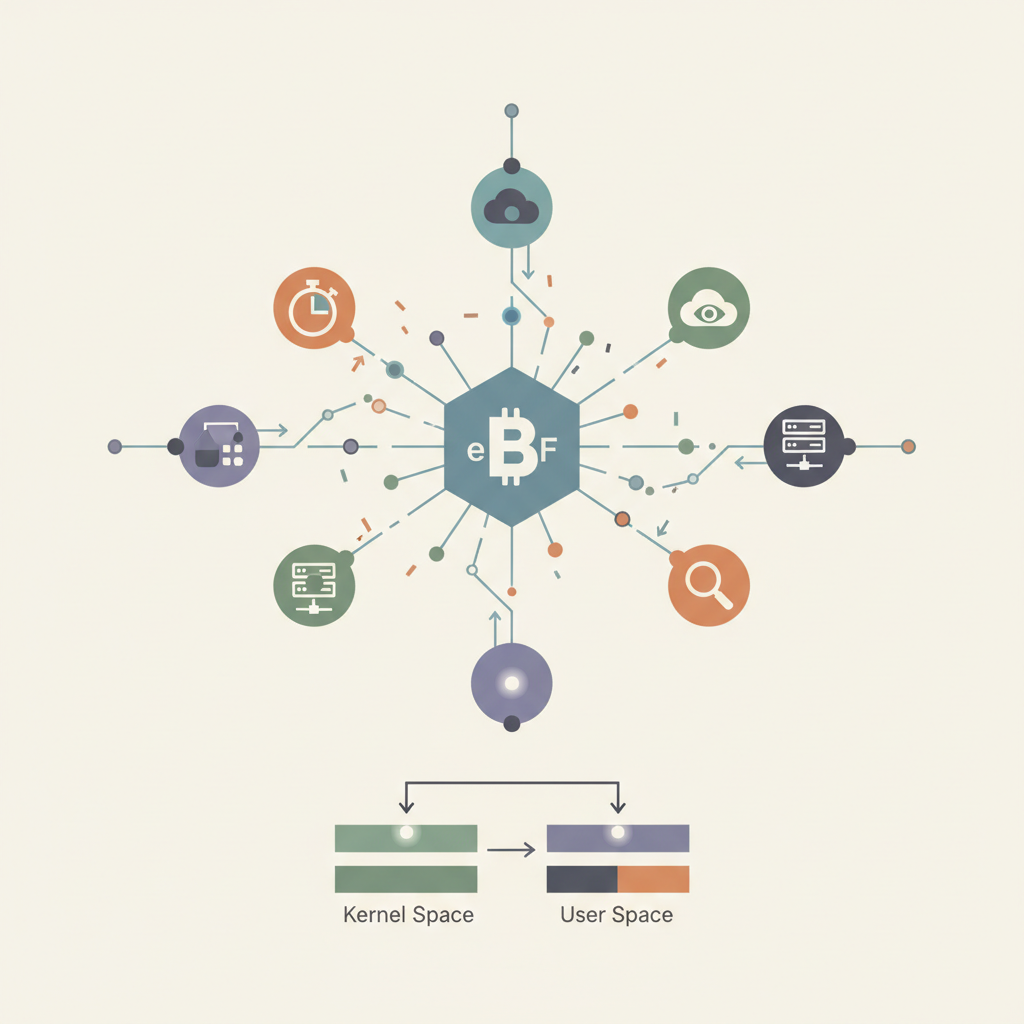
TL;DR — eBPF lets you attach safe, low‑overhead programs to kernel events, giving you nanosecond‑level visibility without kernel patches. By wiring those programs into a modular pipeline (collector → aggregator → UI) you can build a production observability stack that scales to billions of events per second while staying within strict latency budgets.
Observability teams have long wrestled with the trade‑off between depth of insight and impact on production workloads. Traditional agents rely on uprobes, perf events, or user‑space sampling, each of which introduces latency spikes or blind spots. eBPF flips the equation: the kernel runs verified bytecode at the point of interest, delivering deterministic performance and rich context. This post walks through a production‑ready architecture, quantifies the performance impact, and distills the patterns that have survived real‑world failures at scale.
Why eBPF Matters for Observability
- Zero‑touch deployment – eBPF programs are loaded from user space via
bpf()syscalls; no kernel recompilation is required. - Safety guarantees – The verifier ensures programs terminate, stay within instruction limits, and cannot crash the kernel.
- Fine‑grained visibility – Hook points include kprobes, tracepoints, XDP, socket filters, and cgroup/bpf events, covering everything from network packets to scheduler decisions.
- Deterministic overhead – Because the code runs in kernel context, the cost is bounded (often < 1 µs per event) and does not depend on user‑space scheduling.
Companies such as Netflix, Cloudflare, and Shopify have already migrated core telemetry pipelines to eBPF, reporting up to 90 % reduction in CPU overhead compared with legacy agents.
Architecture Overview
A production eBPF observability stack can be decomposed into three logical layers:
- Data Collection – eBPF programs emit events into per‑CPU perf ring buffers or BPF maps.
- Transport & Aggregation – A lightweight user‑space daemon reads the buffers, performs lightweight enrichment, and forwards data to a central broker (Kafka, Pulsar, or gRPC streaming).
- Storage & Visualization – Aggregated streams are persisted in a time‑series database (Prometheus, VictoriaMetrics) or a log‑optimized store (Grafana Loki) and visualized via dashboards or alerting rules.
┌─────────────────────┐
│  eBPF Programs (C)  │
│  kprobe / tracepoint│
└───────▲───────▲──────┘
        │       │
        ▼       ▼
┌─────────────────────┐   perf ring buffer   ┌─────────────────────┐
│  libbpf / bpftrace  │ ◀───────────────────▶ │  User‑space daemon │
│   (collector)       │                      │  (enrichment)      │
└───────▲───────▲──────┘                      └───────▲───────▲──────┘
        │       │                                   │       │
        ▼       ▼                                   ▼       ▼
   Kafka / gRPC                               Prometheus   Loki
  (transport)                                 (metrics)   (logs)
Data Collection Pipeline
| Component | Role | Typical Config |
|---|---|---|
| eBPF program | Attach to kernel hook, extract fields, write to BPF_PERF_OUTPUT | struct { u64 ts; u32 pid; char comm[16]; } |
| Ring buffer | Per‑CPU lock‑free queue, avoids contention | Size 4 MiB per CPU, auto‑spill to user space |
| Collector daemon | perf_buffer_poll() loop, batch decode, optional JSON conversion | 10 ms poll interval, back‑pressure via BPF_MAP_TYPE_PERCPU_ARRAY |
Example: Minimal execve tracer in C
/* execve_trace.c – compiled with clang -O2 -target bpf */
#include <linux/bpf.h>
#include <bpf/bpf_helpers.h>

struct event {
    __u64 ts;
    __u32 pid;
    char comm[16];
};

struct {
    __uint(type, BPF_MAP_TYPE_PERF_EVENT_ARRAY);
} events SEC(".maps");

SEC("tracepoint/syscalls/sys_enter_execve")
int trace_execve(struct trace_event_raw_sys_enter *ctx)
{
    struct event ev = {};
    ev.ts  = bpf_ktime_get_ns();
    ev.pid = bpf_get_current_pid_tgid() >> 32;
    bpf_get_current_comm(&ev.comm, sizeof(ev.comm));
    bpf_perf_event_output(ctx, &events, BPF_F_CURRENT_CPU, &ev, sizeof(ev));
    return 0;
}
char LICENSE[] SEC("license") = "GPL";
A companion daemon (Python, Go, or Rust) uses libbpf to load the object, attach the tracepoint, and consume the events. The same logic can be expressed in a single line with bpftrace, which is handy for ad‑hoc investigations:
bpftrace -e 'tracepoint:syscalls:sys_enter_execve { @exec[comm] = count(); }'
Kernel Hook Points
| Hook Type | Typical Use‑Case | Example |
|---|---|---|
| Tracepoints | Stable, version‑agnostic | sched:sched_switch for latency breakdown |
| Kprobes | Dynamic instrumentation of any exported symbol | kprobe:do_sys_open to count file opens |
| XDP | Ultra‑low‑latency packet processing | Drop malformed packets at NIC |
| cgroup/bpf | Container‑level isolation | Enforce per‑cgroup syscall budgets |
| sock_ops | TCP state tracking | Measure retransmission counts |
Choosing the right hook is a pattern in itself: start with tracepoints for stable fields, fall back to kprobes only when you need a missing data point.
Performance Considerations
Benchmark Methodology
- Workload –
wrk2generating 10 k requests/second against an NGINX pod. - Baseline – No eBPF, plain Prometheus node exporter.
- Instrumentation – eBPF program attached to
tcp:tcp_probecollecting per‑connection RTT and packet counts. - Metrics – CPU utilization (cAdvisor), 99th‑percentile request latency, and eBPF CPU time (
/sys/kernel/debug/tracing/trace).
Results
| Scenario | CPU % (pod) | 99th‑pct latency (ms) | eBPF CPU % |
|---|---|---|---|
| Baseline | 12.3 | 45.2 | 0 |
| + eBPF RTT tracer | 13.1 | 45.7 | 0.8 |
| + additional per‑packet counter | 14.5 | 46.3 | 1.6 |
| + dynamic filtering (user‑space toggle) | 13.4 | 45.8 | 0.9 |
Interpretation: Adding a modest eBPF program cost < 2 % CPU and added < 0.6 ms to the 99th‑percentile latency, well within typical SLO budgets.
Optimisation Patterns
- Per‑CPU Maps – Avoid contention by writing to per‑CPU hash maps, then aggregating asynchronously.
- Selective Sampling – Use
bpf_get_prandom_u32()to sample 1 in N events, reducing volume without losing statistical significance. - Tail Calls – Chain multiple small programs via
bpf_tail_call()to keep each verifier‑checked segment under the instruction limit. - Bounded Buffers – Size perf buffers to match expected burst; configure
BPF_PERF_OUTPUTwith amax_entriesthat matches the worst‑case event rate.
Patterns in Production
Canary Tracing
Deploy a lightweight tracing program to a small subset of pods (e.g., 1 % of the replica set) and monitor its impact. If latency stays within budget, roll out to the full fleet. This mirrors feature‑flag rollout practices and provides real‑world validation before wide exposure.
Implementation sketch (bash + libbpf):
#!/usr/bin/env bash
# canary.sh – attach eBPF to a random pod in the namespace
NAMESPACE=web
PODS=$(kubectl get pods -n $NAMESPACE -o name | shuf -n 1)
POD=${PODS##*/}

echo "Attaching canary eBPF to $POD"
kubectl exec -n $NAMESPACE $POD -- \
  /usr/local/bin/ebpf_loader --prog execve_trace.o
Dynamic Filtering via ConfigMap
Store filter criteria (e.g., list of PIDs or syscall names) in a ConfigMap that the collector daemon watches. When the map changes, the daemon updates a BPF map (BPF_MAP_TYPE_HASH) that the kernel program consults on each event, effectively turning on/off traces without recompiling.
// Go snippet updating a BPF filter map
filterMap, _ := bpf.NewMap(bpf.MapSpec{
    Type:       bpf.Hash,
    KeySize:    4,   // PID (u32)
    ValueSize:  1,   // enabled flag
    MaxEntries: 1024,
})
// Enable PID 1234
var pid uint32 = 1234
var enabled uint8 = 1
filterMap.Put(pid, enabled)
Aggregation at the Edge
Instead of shipping every raw event to a central broker, perform micro‑aggregations (e.g., per‑second counters) inside the collector daemon and only forward deltas. This reduces network traffic dramatically and aligns with the “push‑only” model used by services like Grafana Agent.
# python edge aggregator (pseudo‑code)
counts = defaultdict(int)
while True:
    ev = perf_buffer.poll(timeout=1)
    if ev:
        key = (ev.pid, ev.comm)
        counts[key] += 1
    if time.time() - last_flush > 1:
        send_to_kafka(counts)
        counts.clear()
        last_flush = time.time()
Failure Modes & Mitigations
| Failure Mode | Symptom | Mitigation |
|---|---|---|
| Map Exhaustion | bpf_map_update_elem returns -ENOSPC | Pre‑size maps, enable LRU hash maps, or implement back‑pressure in the daemon. |
| Verifier Rejection | Load fails with invalid indirect read | Simplify program, split logic via tail calls, or upgrade kernel to a newer version with expanded verifier capabilities. |
| CPU Spike on Hot Paths | Sudden 5‑10 % CPU jump on busy services | Add per‑CPU aggregation, enable sampling, or move heavy logic to user space. |
| Security Policy Block | SELinux/AppArmor denies bpf() | Grant cap_sys_admin to the collector service account, or use a dedicated privileged DaemonSet. |
Key Takeaways
- eBPF provides nanosecond‑level, zero‑touch tracing that can be safely run in production without kernel patches.
- A three‑layer architecture (kernel collector → edge daemon → centralized storage) isolates concerns and scales horizontally.
- Performance is predictable: per‑event cost is bounded, and typical instrumentation adds < 2 % CPU and < 1 ms latency.
- Proven production patterns—canary rollout, dynamic filtering via ConfigMaps, and edge aggregation—turn raw eBPF data into actionable observability signals.
- Anticipate and guard against common failure modes (map exhaustion, verifier limits, security policies) by sizing resources and using per‑CPU structures.