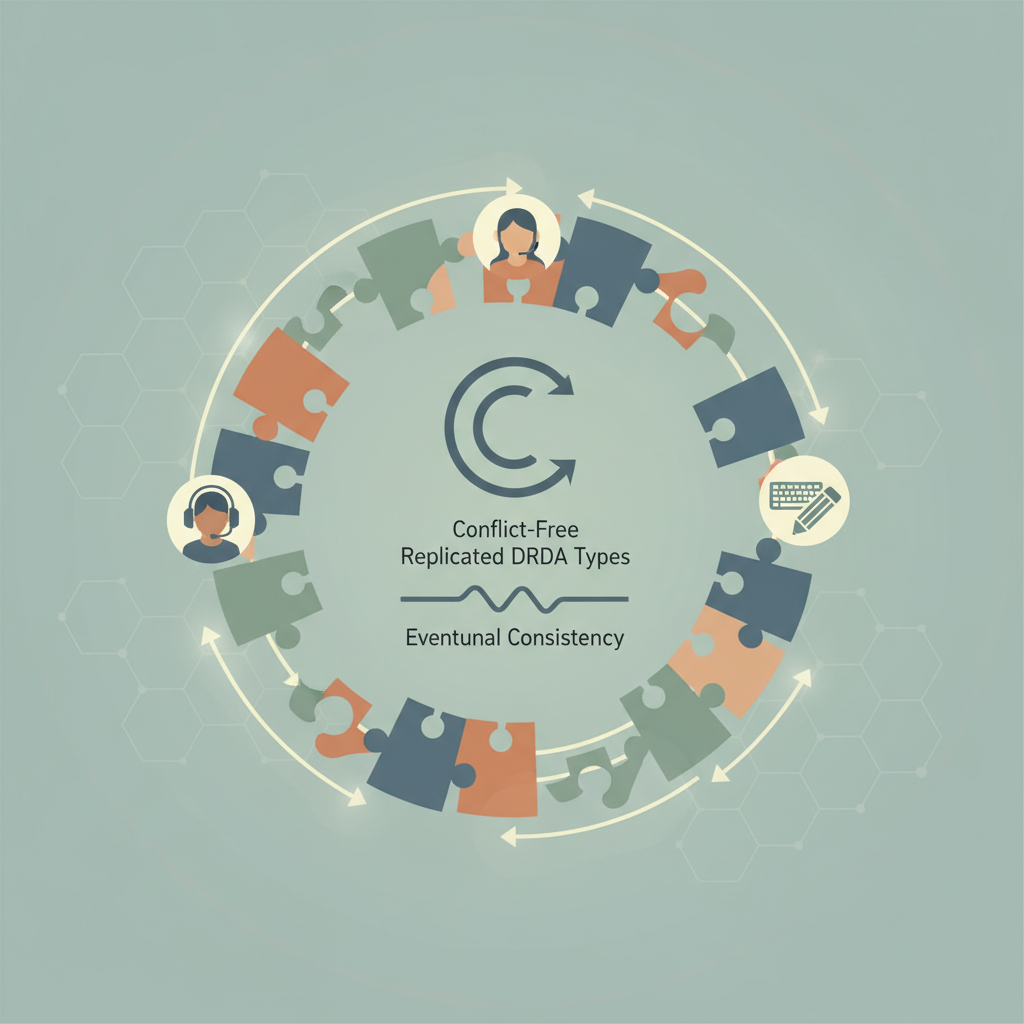
Diagram showing nodes synchronizing CRDT states in a peer-to-peer network.

Implementing Conflict-Free Replicated Data Types for Eventual Consistency in Distributed Collaborative Systems

A practical guide to building CRDT-powered collaborative applications, covering theory, common data types, implementation patterns, and performance tips.

May 13, 2026 · 8 min · 1509 words · martinuke0
Diagram of nodes replicating a CRDT data structure.

Implementing Conflict-Free Replicated Data Types for Eventual Consistency in Distributed Systems

A deep dive into CRDTs, covering their theory, common types, and step‑by‑step guidance for integrating them into distributed applications.

May 13, 2026 · 8 min · 1655 words · martinuke0

Scaling Distributed State with Conflict-Free Replicated Data Types and Causal Consistency Mechanisms

Table of Contents Introduction Why Distributed State Is Hard Fundamentals of Conflict‑Free Replicated Data Types (CRDTs) 3.1 State‑Based (CvRDT) vs. Operation‑Based (CmRDT) 3.2 Common CRDT Families Causal Consistency: The Missing Piece 4.1 Definitions and Guarantees 4.2 Vector Clocks and Version Vectors Merging CRDTs with Causal Consistency 5.1 Delta‑State CRDTs (Δ‑CRDTs) 5.2 Causally‑Ordered Delivery Design Patterns for Scalable Distributed State 6.1 Sharding and Partitioning 6.2 Event‑Sourcing with CRDTs 6.3 Hybrid Approaches: CRDT + Consensus Practical Example: Real‑Time Collaborative Text Editor 7.1 Data Model Using a Sequence CRDT 7.2 Implementation Sketch in TypeScript Implementation in Different Languages 8.1 Rust with crdts crate 8.2 Go with go‑crdt 8.3 JavaScript/TypeScript with automerge Performance, Latency, and Bandwidth Considerations Operational Concerns and Monitoring Challenges, Open Problems, and Future Directions 12 Conclusion 13 Resources Introduction Modern applications—social networks, collaborative productivity suites, multiplayer games, and IoT platforms—must serve millions of users while maintaining a responsive, always‑available experience. To achieve this, developers often replicate state across geographically distributed data centers, edge nodes, and even client devices. Replication brings latency benefits, but it also introduces the classic CAP trade‑off: guaranteeing consistency across all replicas while tolerating network partitions is impossible without sacrificing availability. ...

May 12, 2026 · 15 min · 3134 words · martinuke0

Solving Distributed Data Consistency Challenges in Local-First Collaborative Applications with CRDTs

Table of Contents Introduction What Is a Local‑First Architecture? The Consistency Problem in Distributed Collaboration CRDTs 101: Core Concepts and Taxonomy Choosing the Right CRDT for Your Data Model Designing a Local‑First Collaborative App with CRDTs Practical Example 1: Real‑Time Collaborative Text Editor Practical Example 2: Shared Todo List Using an OR‑Set Performance, Bandwidth, and Storage Considerations Security & Privacy in Local‑First CRDT Apps Testing, Debugging, and Observability Deployment Patterns: Peer‑to‑Peer, Client‑Server, Hybrid Future Directions and Emerging Tools Conclusion Resources Introduction In the last decade, the local‑first paradigm has reshaped how we think about collaborative software. Instead of forcing every user to stay online and rely on a central server for the source of truth, local‑first applications treat the device’s local storage as the primary repository of data. Syncing with other peers or a cloud backend happens after the user has already made progress, even while offline. ...

April 1, 2026 · 17 min · 3568 words · martinuke0

Eventual Consistency: Theory, Practice, and Real‑World Applications

Introduction In the era of globally distributed applications—social networks, e‑commerce platforms, IoT back‑ends, and multiplayer games—systems must serve users from data centers spread across continents while still delivering low‑latency responses. Achieving high availability under these conditions is impossible without compromising on consistency in some way, a reality formalized by the CAP theorem. Eventual consistency is the most widely adopted compromise. It promises that, if no new updates are made to a given data item, all replicas will eventually converge to the same value. This simple guarantee hides a rich set of design decisions, algorithms, and operational practices that enable massive scalability. ...

March 30, 2026 · 15 min · 3125 words · martinuke0
Feedback