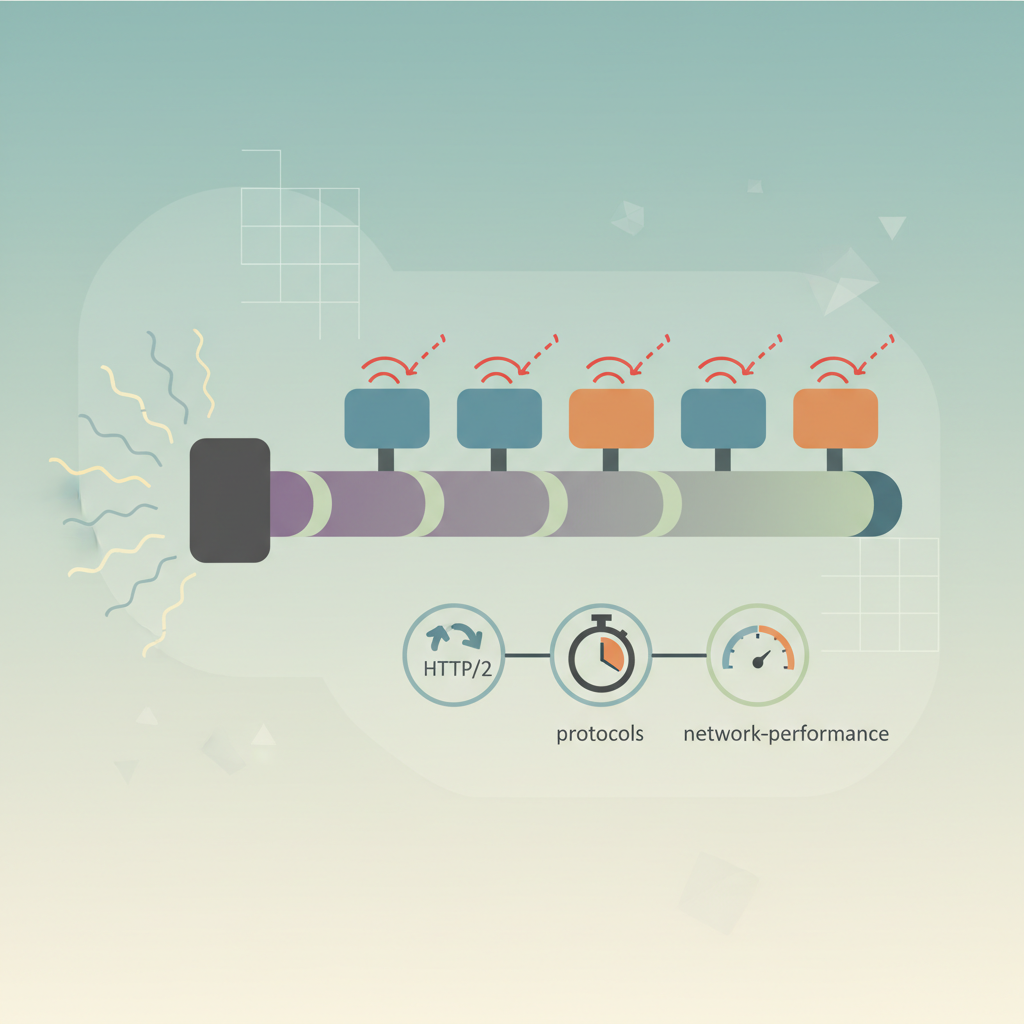
The Latency Cost of HTTP/2 Head-of-Line Blocking
A deep dive into HTTP/2’s hidden head‑of‑line blocking problem, its performance consequences, and practical ways to reduce latency.
A deep dive into HTTP/2’s hidden head‑of‑line blocking problem, its performance consequences, and practical ways to reduce latency.
Introduction The web has been built on a series of incremental protocol improvements. From the original HTTP/0.9, through the widely‑deployed HTTP/1.1, to the multiplexed, binary HTTP/2, each version has tackled the performance bottlenecks of its predecessor. Yet, the underlying transport layer—TCP—has become a limiting factor in an era dominated by mobile devices, high‑latency networks, and ever‑growing media payloads. Enter HTTP/3, the first major web protocol that abandons TCP entirely in favor of QUIC (Quick UDP Internet Connections), a transport protocol built on top of UDP. HTTP/3 promises faster connection establishment, reduced head‑of‑line blocking, built‑in encryption, and smoother migration across network changes. In this article we will: ...
Table of Contents Introduction What Is the Set-Cookie Header? Syntax and Core Attributes 3.1 Name‑Value Pair 3.2 Expiration Controls 3.3 Scope Controls 3.4 Security Flags SameSite and Modern Browser Policies Real‑World Use Cases 5.1 Session Management 5.2 Persistent Preferences 5.3 A/B Testing & Feature Flags Implementing Set-Cookie in Popular Back‑Ends 6.1 Node.js / Express 6.2 Python / Flask 6.3 Java / Spring Boot 6.4 Go / net/http Debugging and Testing Cookies Best Practices Checklist Future Directions: Cookie Partitioning & Storage Access API Conclusion Resources Introduction HTTP is a stateless protocol. Each request that reaches a server is, by design, independent of any previous request. Yet modern web applications need to remember who a user is, what items they have in a shopping cart, or which language they prefer. Cookies—small pieces of data stored on the client—fill that gap. ...
Introduction Real‑time communication has become a cornerstone of modern web applications. From live sports scores to collaborative editing tools, users expect instant updates without the need to manually refresh a page. While WebSockets often steal the spotlight, Server‑Sent Events (SSE) provide a simpler, standards‑based alternative for one‑way streaming from server to client. In this article we will explore SSE from the ground up: What SSE is and how it differs from other real‑time techniques. The wire protocol that powers SSE, including headers and event formatting. Server‑side implementations in popular runtimes (Node.js, Python, Go, Java). Client‑side consumption via the native EventSource API, custom events, and reconnection strategies. Best practices for security, scaling, and reliability. A handful of real‑world scenarios where SSE shines. By the end you’ll be equipped to decide when SSE is the right tool for your project, and you’ll have concrete code you can copy‑paste into production. ...
Introduction Since its launch in 2022, Bun has rapidly become one of the most talked‑about JavaScript runtimes. Built on top of the Zig programming language and the JavaScriptCore engine, Bun promises blazing‑fast start‑up times, low memory footprints, and a batteries‑included standard library that includes a modern HTTP server. If you’ve spent years building APIs with Node.js, Express, or Fastify, you might wonder whether Bun’s HTTP server can replace—or at least complement—your existing stack. This article dives deep into the Bun HTTP server, covering everything from installation and basic usage to advanced routing, middleware, WebSockets, performance tuning, and production deployment. By the end, you’ll have a production‑ready codebase and a clear understanding of where Bun shines and where you still might need to reach for other tools. ...