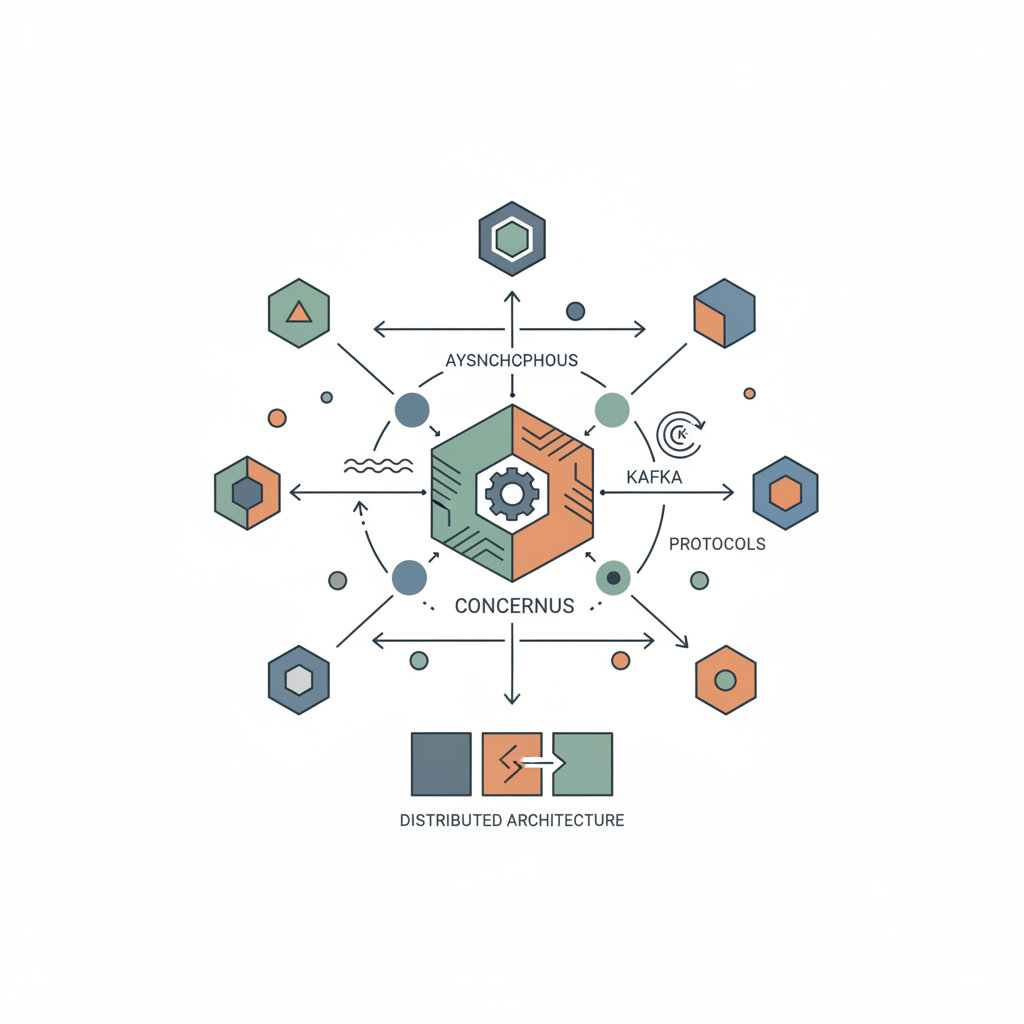
Implementing Asynchronous State Propagation in Decentralized Multi‑Agent Edge Inference Systems

Table of Contents Introduction Why Decentralized Multi‑Agent Edge Inference? Fundamental Concepts Asynchronous Messaging State Propagation Models Consistency vs. Latency Trade‑offs Architectural Blueprint Edge Node Stack Network Topology Choices Middleware Layer Propagation Mechanisms in Detail Gossip / Epidemic Protocols Publish‑Subscribe (Pub/Sub) Meshes Conflict‑Free Replicated Data Types (CRDTs) Practical Implementation Walk‑Through Setting Up an Async Runtime (Python + asyncio) Gossip‑Based State Sync Example CRDT‑Backed Model Parameter Exchange Performance Optimisation Techniques Message Batching & Compression Prioritising Critical Updates Edge‑Aware Back‑Pressure Security and Trust Considerations Evaluation Methodology Future Directions & Open Research Questions Conclusion Resources Introduction Edge computing has moved from a niche concept to a mainstream architectural pattern, especially for AI‑driven applications that demand sub‑100 ms latency. In many real‑world deployments—autonomous drones, collaborative robotics, smart‑city sensor grids—the inference workload is distributed across a decentralized swarm of heterogeneous agents. These agents must continuously share context, model updates, and sensor observations while operating under strict bandwidth, power, and latency constraints. ...

April 1, 2026 · 12 min · 2432 words · martinuke0

Scaling Agentic RAG with Federated Knowledge Graphs and Hierarchical Multi‑Agent Orchestration

Introduction Retrieval‑Augmented Generation (RAG) has become the de‑facto pattern for building LLM‑powered applications that require up‑to‑date, factual grounding. The classic RAG loop—retrieve → augment → generate—works well when the underlying corpus is static, modest in size, and centrally stored. In real‑world enterprises, however, knowledge is: Distributed across departments, clouds, and edge devices. Highly dynamic, with frequent schema changes, regulatory updates, and domain‑specific nuances. Sensitive, requiring strict data‑privacy and compliance guarantees. To meet these constraints, a new generation of agentic RAG systems is emerging. These systems treat each retrieval or reasoning component as an autonomous “agent” capable of issuing tool calls, negotiating with peers, and learning from interaction. When combined with federated knowledge graphs (FKGs)—graph databases that are physically partitioned but logically unified—agentic RAG can scale to billions of entities while respecting data sovereignty. ...
April 1, 2026 · 10 min · 1984 words · martinuke0

Unlocking Multi-Agent Magic: In-Process Swarms in AI Coding Assistants

Unlocking Multi-Agent Magic: In-Process Swarms in AI Coding Assistants In the rapidly evolving world of AI-driven software development, single-agent systems are giving way to sophisticated multi-agent architectures that mimic human teams. Imagine a “leader” AI orchestrating a squad of specialized “teammate” agents, each tackling subtasks in parallel—without the overhead of spinning up separate processes. This is the power of in-process swarms, a technique pioneered in tools like Claude Code, where agents collaborate within the same runtime environment for lightning-fast coordination and resource efficiency. ...

March 31, 2026 · 7 min · 1340 words · martinuke0

Beyond Large Language Models: Orchestrating Multi‑Agent Systems with the New Open‑Source Swarm Protocol

Introduction Large language models (LLMs) have transformed how we generate text, answer questions, and even write code. Yet, as powerful as a single LLM can be, many real‑world problems demand coordination, division of labor, and continuous feedback loops that a solitary model cannot provide efficiently. Enter multi‑agent systems: collections of specialized AI agents that communicate, negotiate, and collaborate to solve complex tasks. While the idea of swarms of agents is not new—researchers have explored it for decades—the recent release of the open‑source Swarm Protocol (often simply called Swarm) has lowered the barrier to building production‑grade, LLM‑driven multi‑agent pipelines. ...

March 31, 2026 · 12 min · 2375 words · martinuke0

Optimizing Asynchronous Consensus Protocols for Decentralized Multi‑Agent Decision Engines in High‑Frequency Trading

Introduction High‑frequency trading (HFT) thrives on microseconds. In a market where a single millisecond can represent thousands of dollars, the latency of every software component matters. Modern HFT firms are moving away from monolithic order‑routing engines toward decentralized multi‑agent decision engines (DMAD‑E). In such architectures, dozens or hundreds of autonomous agents—each responsible for a specific market‑view, risk model, or strategy—collaborate to decide which orders to send, modify, or cancel. The collaboration point is a consensus layer that guarantees all agents agree on a shared decision (e.g., “execute 10,000 shares of X at price Y”). Traditional consensus protocols (e.g., classic Paxos or Raft) were designed for durability and fault tolerance in data‑center environments, not for the sub‑millisecond response times required by HFT. Consequently, asynchronous consensus—which tolerates variable message delays and does not rely on synchronized clocks—has become the focus of research and production engineering. ...

March 30, 2026 · 11 min · 2197 words · martinuke0
Feedback