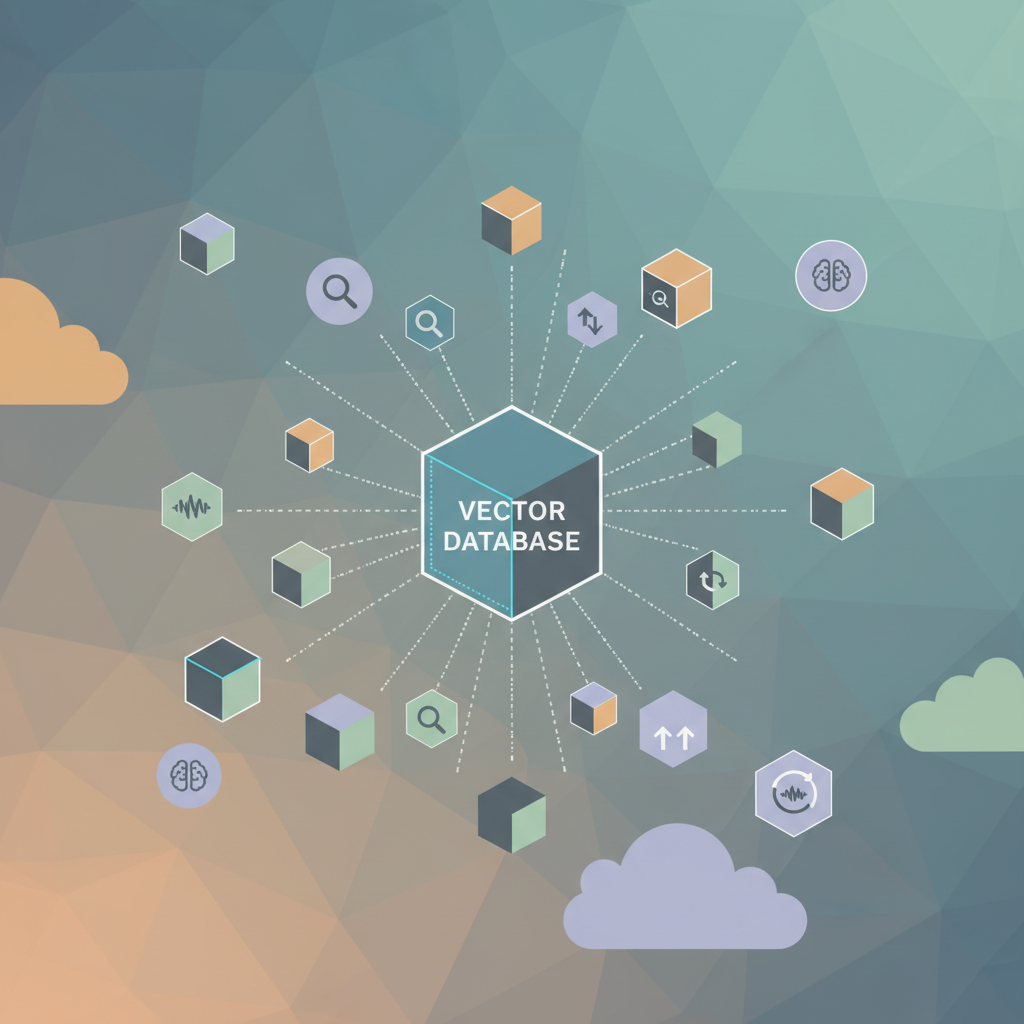
Distributed Vector Database Architecture: Zero‑to‑Hero Guide for Building Scalable High‑Performance Semantic Search Engines

Table of Contents Introduction Why Vector Search Matters Today Core Concepts 3.1 Embeddings & Vector Representations 3.2 Similarity Metrics 3.3 [From Brute‑Force to Approximate Nearest Neighbor (ANN)] Challenges of Scaling Vector Search Distributed Vector Database Building Blocks 5.1 Ingestion Pipeline 5.2 Sharding & Partitioning Strategies 5.3 Indexing Engines (IVF, HNSW, PQ, etc.) 5.4 Replication & Consistency Models 5.5 Query Router & Load Balancer 5.6 Caching Layers 5.7 Metadata Store & Filtering Design Patterns for a Distributed Vector Store 6.1 Consistent Hashing + Virtual Nodes 6.2 Raft‑Based Consensus for Metadata 6.3 Parameter‑Server Style Vector Updates Performance Optimizations 7.1 Hybrid Indexing (IVF‑HNSW) 7.2 Product Quantization & OPQ 7.3 GPU Acceleration & Batch Queries 7.4 Network‑Aware Data Placement Observability, Monitoring, and Alerting Security & Access Control Step‑by‑Step Hero Build: From Zero to a Production‑Ready Engine 10.1 Choosing the Stack (Milvus + Ray + FastAPI) 10.2 Schema Design & Metadata Modeling 10.3 Ingestion Code Sample 10.4 Index Creation & Tuning 10.5 Deploying a Distributed Cluster with Docker‑Compose & K8s 10.6 Query API & Real‑World Use Case 10.7 Benchmarking & Scaling Tests Common Pitfalls & How to Avoid Them Conclusion Resources Introduction Semantic search has moved from a research curiosity to a core capability for modern applications—think product recommendation, code search, legal document retrieval, and conversational AI. At its heart lies vector similarity search, where high‑dimensional embeddings capture the meaning of text, images, or audio, and the system finds the nearest vectors to a query. ...

March 31, 2026 · 15 min · 3073 words · martinuke0

Mastering Distributed Vector Embeddings for High‑Performance Semantic Search in Serverless Architectures

Introduction Semantic search has moved from a research curiosity to a production‑ready capability that powers everything from e‑commerce recommendation engines to enterprise knowledge bases. At its core, semantic search relies on vector embeddings—dense, high‑dimensional representations of text, images, or other modalities that capture meaning in a way that traditional keyword matching cannot. While the algorithms for generating embeddings are now widely available (e.g., OpenAI’s text‑embedding‑ada‑002, Hugging Face’s sentence‑transformers), delivering low‑latency, high‑throughput search over billions of vectors remains a formidable engineering challenge. This challenge is amplified when you try to run the service in a serverless environment—where you have no control over the underlying servers, must contend with cold starts, and need to keep costs predictable. ...

March 28, 2026 · 12 min · 2486 words · martinuke0

Architecting Low‑Latency Inference Pipelines for Real‑Time Edge‑Native Semantic Search Systems

Table of Contents Introduction What Is Edge‑Native Semantic Search? Latency Bottlenecks in Real‑Time Inference Core Architectural Principles 4.1 Model Selection & Optimization 4.2 Data Pre‑Processing at the Edge 4.3 Hardware‑Accelerated Execution Pipeline Design Patterns for Low Latency 5.1 Synchronous vs. Asynchronous Execution 5.2 Smart Batching & Micro‑Batching 5.3 Quantization, Pruning, and Distillation Practical Walk‑Through: Building an Edge‑Native Semantic Search Service 6.1 System Overview 6.2 Model Choice: Sentence‑Transformer Lite 6.3 Deploying on NVIDIA Jetson Or Google Coral 6.4 Code Example: End‑to‑End Async Inference Monitoring, Observability, and SLA Enforcement Scalability & Fault Tolerance on the Edge Security & Privacy Considerations Future Directions: Tiny Foundation Models & On‑Device Retrieval Conclusion Resources Introduction Semantic search—retrieving information based on meaning rather than exact keyword matches—has become a cornerstone of modern AI‑driven applications. From voice assistants that understand intent to recommendation engines that surface contextually relevant content, the ability to embed queries and documents into a shared vector space is at the heart of these systems. ...

March 20, 2026 · 13 min · 2559 words · martinuke0

Vector Databases and Semantic Search Architecture: Implementation, Code, and Performance Benchmarks

Table of Contents Introduction Why Traditional Search Falls Short Fundamentals of Vector Search 3.1 Embeddings Explained 3.2 Similarity Metrics Choosing a Vector Database 4.1 Open‑Source Options 4.2 Managed Cloud Services Designing a Semantic Search Architecture 5.1 Data Ingestion Pipeline 5.2 Embedding Generation 5.3 Indexing Strategies 5.4 Query Flow Hands‑On Implementation with Milvus and Sentence‑Transformers 6.1 Environment Setup 6.2 Creating the Collection 6.3 Batch Ingestion Code 6.4 Search API Endpoint (FastAPI) Performance Benchmarking Methodology 7.1 Dataset & Hardware 7.2 Metrics Captured 7.3 Benchmark Results Tuning for Scale and Latency 8.1 Index Parameters 8.2 Sharding & Replication 8.3 Hardware Acceleration Best Practices & Common Pitfalls Conclusion Resources Introduction Semantic search has moved from a research curiosity to a production‑ready capability that powers everything from recommendation engines to enterprise knowledge bases. The core idea is simple: instead of matching exact keywords, we embed documents and queries into a high‑dimensional vector space where semantic similarity can be measured directly. ...

March 16, 2026 · 10 min · 2010 words · martinuke0

Architecting Scalable Vector Databases for Production‑Grade Large Language Model Applications

Introduction Large Language Models (LLMs) such as GPT‑4, Claude, or Llama 2 have turned natural language processing from a research curiosity into a core component of modern products. While the models themselves excel at generation and reasoning, many real‑world use‑cases—semantic search, retrieval‑augmented generation (RAG), recommendation, and knowledge‑base Q&A—require fast, accurate similarity search over millions or billions of high‑dimensional vectors. That is where vector databases come in. They store embeddings (dense numeric representations) and provide nearest‑neighbor (NN) queries that are orders of magnitude faster than brute‑force scans. However, moving from a proof‑of‑concept notebook to a production‑grade service introduces a whole new set of challenges: scaling horizontally, guaranteeing low latency under heavy load, ensuring data durability, handling multi‑tenant workloads, and meeting security/compliance requirements. ...

March 13, 2026 · 13 min · 2581 words · martinuke0
Feedback