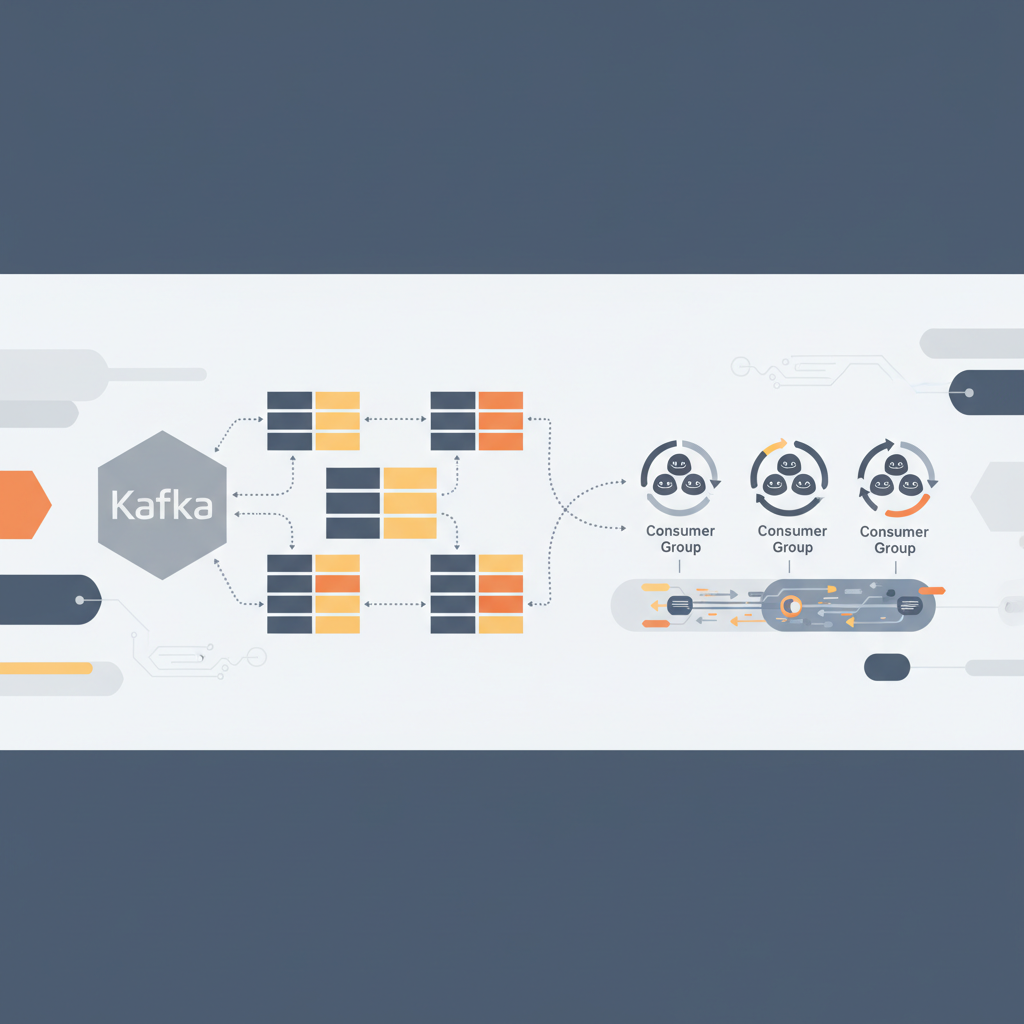
Illustration of Kafka brokers with partitioned topics and consumer groups.

Mastering Apache Kafka Topic Partitioning and Consumer Group Rebalancing: From Basics to Production-Ready Pipelines

Learn how to design partition strategies, handle rebalancing safely, and implement production‑ready Kafka pipelines that stay resilient under load.

May 25, 2026 · 6 min · 1252 words · martinuke0
Illustration of a flowing data stream with timestamp markers.

How Stream Watermarks Define Event Time Progress

Watermarks are the backbone of event‑time handling in modern stream processors. This post explains their purpose, generation, and impact on windowing.

May 17, 2026 · 7 min · 1288 words · martinuke0

Architecting Low‑Latency Stateful Streaming Pipelines for High‑Performance Distributed Machine Learning

Introduction The rise of real‑time analytics, online personalization, and continuous model improvement has pushed the limits of traditional batch‑oriented machine‑learning (ML) pipelines. Modern applications—ranging from fraud detection to recommendation engines—must ingest massive streams of events, maintain per‑entity state, and feed that state into sophisticated ML models within milliseconds. Achieving such low latency while preserving stateful correctness and fault‑tolerance is non‑trivial. It requires a careful blend of streaming architecture, state management techniques, networking optimizations, and tight integration with distributed ML frameworks. ...

March 27, 2026 · 15 min · 3063 words · martinuke0

WebSockets, Webhooks, and WebStreaming: A Deep Dive into Real‑Time Communication on the Modern Web

Table of Contents Introduction Why Real‑Time Matters Today WebSockets 3.1 Protocol Overview 3.2 Handshake & Message Framing 3.3 Node.js Example 3.4 Scaling WebSocket Services 3.5 Security Considerations Webhooks 4.1 What a Webhook Is 4.2 Typical Use‑Cases 4.3 Implementing a Webhook Receiver (Express) 4.4 Reliability Patterns (Retries, Idempotency) 4.5 Security & Validation WebStreaming 5.1 Definitions & Core Protocols 5.2 HTTP Live Streaming (HLS) 5.3 MPEG‑DASH 5.4 WebRTC & Peer‑to‑Peer Streaming 5.5 Server‑Sent Events (SSE) vs. WebSockets Choosing the Right Tool for the Job Hybrid Architectures Best Practices & Operational Tips Future Trends in Real‑Time Web Communication Conclusion Resources Introduction The web has evolved from a document‑centric universe to a real‑time, event‑driven ecosystem. Users now expect chat messages to appear instantly, dashboards to refresh without a click, and video streams to start on demand. Underpinning this shift are three foundational patterns: ...

March 27, 2026 · 16 min · 3392 words · martinuke0

From Batch to Real‑Time: Mastering Event‑Driven Architectures with Apache Kafka

Introduction For decades, enterprises have relied on batch jobs to move, transform, and analyze data. Nightly ETL pipelines, scheduled reports, and periodic data warehouses have been the backbone of decision‑making. Yet the business landscape is changing: customers expect instant feedback, fraud detection must happen in milliseconds, and Internet‑of‑Things (IoT) devices generate a continuous flood of events. Enter event‑driven architecture (EDA)—a paradigm where systems react to streams of immutable events as they happen. At the heart of modern EDA is Apache Kafka, a distributed log that can ingest billions of events per day, guarantee ordering per partition, and provide durable storage for as long as you need. ...
March 12, 2026 · 9 min · 1900 words · martinuke0
Feedback