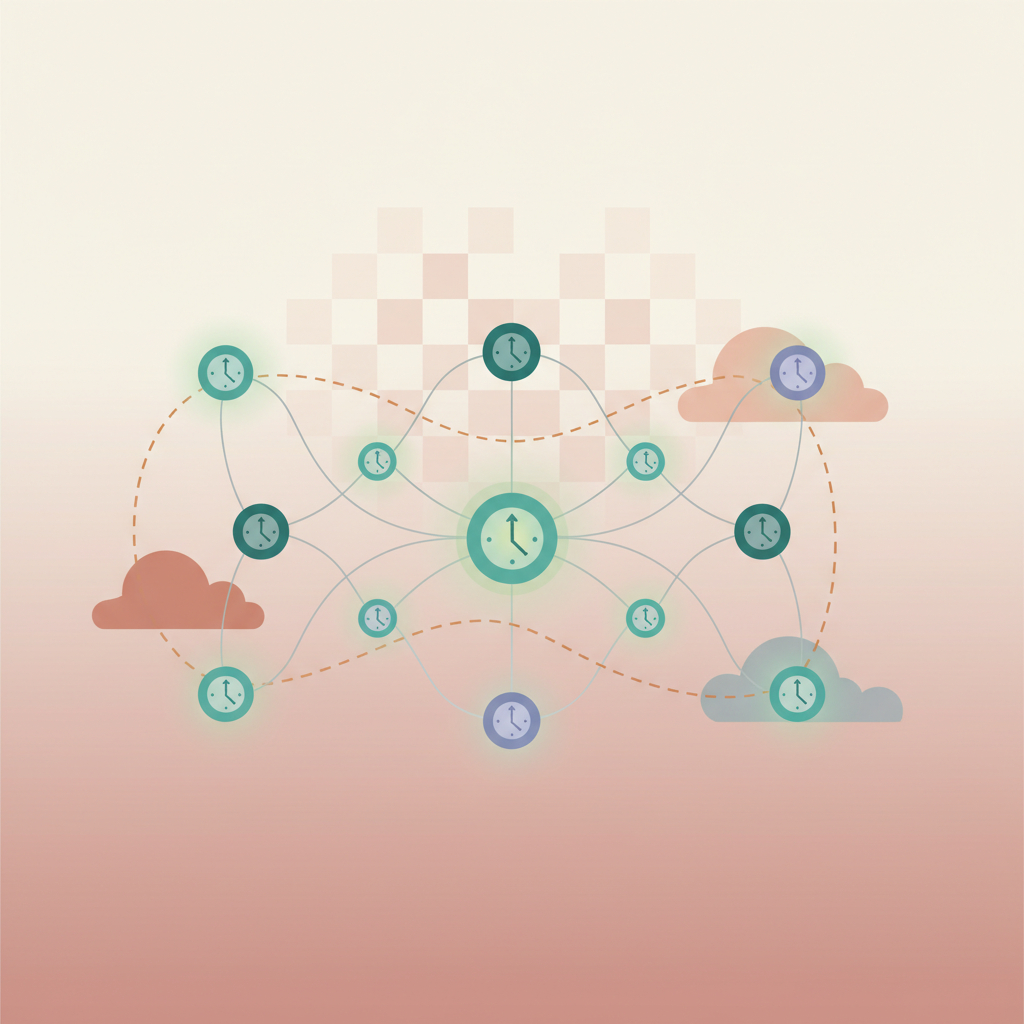
Implementing Vector Clocks for Causal Consistency in Distributed Multi-Agent State Synchronization
A step‑by‑step guide to designing, implementing, and tuning vector clocks for reliable state synchronization across distributed agents.
A step‑by‑step guide to designing, implementing, and tuning vector clocks for reliable state synchronization across distributed agents.
A deep dive into consistency models, vector clocks, and how they combine to guarantee linearizability in distributed state machines.
Introduction In modern computing, distributed systems have become the backbone of everything from cloud services to collaborative editing tools. One of the most fundamental challenges in such environments is determining the order of events that happen across multiple, potentially unreliable nodes. While physical clocks can provide a rough sense of time, they are insufficient for reasoning about causality—the “happened‑before” relationship that underpins consistency guarantees, conflict resolution, and debugging. Enter vector clocks. First introduced in the early 1990s as an extension of Leslie Lamport’s logical clocks, vector clocks give each process a compact, deterministic way to capture causal relationships without requiring synchronized hardware clocks. They are simple enough to implement in a few lines of code, yet powerful enough to underpin the design of large‑scale databases (e.g., Amazon Dynamo, Apache Cassandra), version‑control systems, and real‑time collaborative editors. ...
Table of Contents Introduction Why Ordering Matters in Distributed Systems From Lamport Clocks to Vector Clocks Formal Definition of Vector Clocks Operations on Vector Clocks Practical Implementation (Python & Java) Real‑World Use Cases 7.1 Dynamo‑style Key‑Value Stores 7.2 Version Control Systems 7.3 Collaborative Editing Scalability Challenges and Optimizations Testing and Debugging Vector‑Clock Logic 10 Best Practices 11 Conclusion 12 Resources Introduction When multiple processes or nodes operate concurrently without a shared global clock, determining the causal relationship between events becomes non‑trivial. Distributed systems must answer questions such as: ...