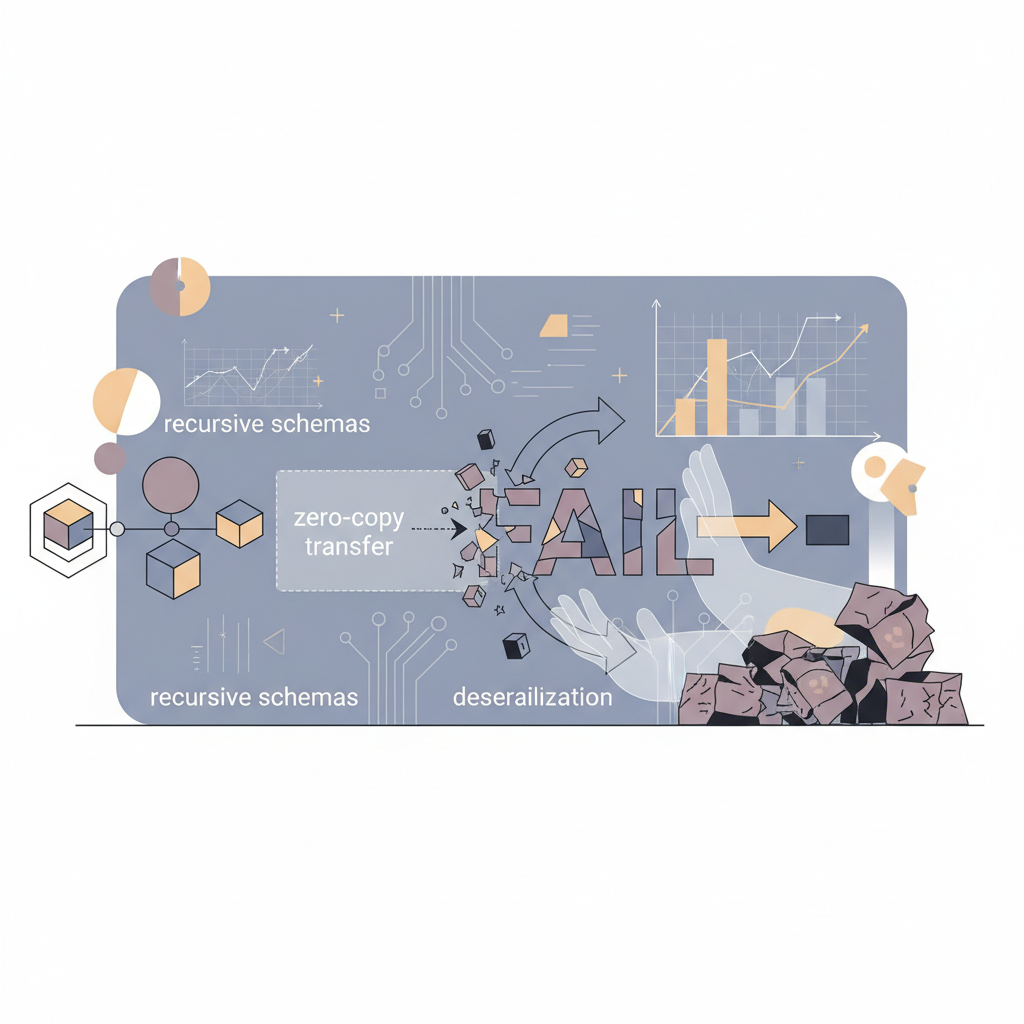
Why Zero-Copy Deserialization Fails for Large Recursive Schemas
An in‑depth look at why zero‑copy deserialization breaks down for large recursive schemas, illustrated with Rust and C++ examples and practical mitigation strategies.
An in‑depth look at why zero‑copy deserialization breaks down for large recursive schemas, illustrated with Rust and C++ examples and practical mitigation strategies.
Learn how zero-copy deserialization eliminates data copies in high‑speed network drivers, with practical code patterns and performance benchmarks.
A deep dive into zero‑copy serialization techniques in Rust, showing how to minimize allocations, avoid copies, and keep latency low in distributed state transfer.
Introduction State machines are a timeless abstraction for modeling deterministic behavior. Whether you are orchestrating a traffic light, coordinating a micro‑service workflow, or implementing a protocol stack, the notion of states and transitions gives you a clear, testable contract. The challenge emerges when those machines must operate at scale across many nodes, handle high throughput, and remain resilient to failures. Traditional approaches—centralized coordinators, heavyweight RPC layers, or naïve thread‑per‑machine designs—often crumble under the pressure of modern cloud workloads. ...
Table of Contents Introduction Why Low Latency Is Critical in Finance Core Challenges of Real‑Time Financial Stream Processing Rust: The Language of Choice for Ultra‑Fast Systems Zero‑Copy Architecture Explained Designing a Low‑Latency Pipeline in Rust 6.1 Ingestion Layer 6.2 Parsing & Deserialization 6.3 Enrichment & Business Logic 6.4 Aggregation & Windowing 6.5 Publishing Results Practical Example: A Real‑Time Ticker Processor 7.1 Project Layout 7.2 Zero‑Copy Message Types 7.3 Ingestion with mio + socket2 7.4 Lock‑Free Queues with crossbeam 7.5 Putting It All Together Performance Tuning Techniques 8.1 Cache‑Friendly Data Layouts 8.2 Avoiding Memory Allocations 8.3 NUMA‑Aware Thread Pinning 8.4 Profiling with perf and flamegraph Integration with Existing Ecosystems Testing, Benchmarking, and Reliability Deployment and Observability Conclusion Resources Introduction Financial markets move at breakneck speed. A millisecond advantage can translate into millions of dollars, especially in high‑frequency trading (HFT), market‑making, and risk‑management scenarios. Consequently, the software infrastructure that consumes, processes, and reacts to market data must be engineered for ultra‑low latency and deterministic performance. ...